The national government is accelerating a massive wave of mega infrastructure and strategic development projects in the coastal region to spur economic growth and prosperity.
The region is undergoing a massive multibillion-shillings infrastructure overhaul to strengthen and support its long-term socio-economic development.
The coastal infrastructure landscape is undergoing a significant transformation through its mega projects that seek to position the region as a major economic and logistics hub.
The coastal region, home to the Port of Mombasa along the Indian Ocean, serves as East Africa’s premier maritime gateway, the primary trade corridor for Kenya and landlocked neighbors like Uganda, Rwanda, Burundi, South Sudan, and the Democratic Republic of Congo.
Among the ongoing legacy infrastructure projects include the Sh20 billion Mwache multipurpose dam project, the Sh7.5 billion multinational Bagamoyo–Tanga–Horohoro/Lungalunga–Malindi road project, the Sh16 billion Taifa Gas liquefied petroleum gas terminal at the Dongo Kundu Special Economic Zone.
The Mwache Multipurpose Dam Project in Kwale is being implemented to strengthen water security and support sustainable economic growth across the coastal region.
Implemented under the Coast Region Water Security and Climate Resilience Project, the dam is poised to become a transformative asset for the coast region unlocking growth and strengthening resilience against climate-related shocks.
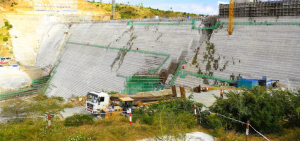
The water project with a storage capacity of approximately 127 million cubic meters is now in its final stages of construction, with major works at 99 percent complete.
Other landmark infrastructure development and economic projects in the region include the Sh32 billion Dongo Kundu Bypass, Sh48 billion Lamu port project, the Sh2.6 billion Shimoni fish port project, the Sh. 12.5 billion Galana-Kulalu Food Security project, the Sh7.5 billion Mtwapa Bridge and the proposed Sh455 billion Mombasa-Nairobi expressway.
The new Mtwapa Bridge is a 345-meter, four-lane dual-carriageway project being built by the Kenya National Highways Authority (KeNHA) along the Mombasa-Malindi (A7) corridor designed to replace a major traffic bottleneck between Mombasa and Kilifi counties and features a 162-meter main span and pedestrian pathways.
All the projects have also generated significant employment opportunities for local communities by hiring local workers to implement activities and buying goods and services from local firms.
According to Kenya Ports Authority (KPA) Chief Executive Officer Capt. William Ruto the new Shimoni Fish Port project in Kwale is now fully complete and officially handed over to the Kenya Ports Authority, marking a major milestone in the growth of the blue economy sector.
Capt. Ruto said as the country’s first industrial maritime hub dedicated exclusively to commercial fishing and fish processing, the facility is expected to transform the coastal fisheries sector and strengthen Kenya’s position in regional and international seafood markets.
Designed to handle up to 50,000 metric tons of fish annually, the fishing port features a modern commercial jetty and causeway, a fish processing and value-addition facility, industrial cold storage and ice-making systems, as well as supporting infrastructure for efficient and environmentally sustainable operations.
Also coming up is the National Mariculture Resource and Training Centre (NAMARET) in Shimoni, managed by the Kenya Marine and Fisheries Research Institute and is a premier facility for marine aquaculture research, seed production and capacity building, playing a strategic role in advancing the Blue Economy and expanding sustainable livelihoods along the Coast.
The Centre upon completion will drive innovation across key areas of marine aquaculture, including sea cucumber culture for high-value export markets, seaweed farming, marine finfish production and coral reef restoration.
All the infrastructure projects traverse areas where fishing, agriculture, transport and tourism are the main economic activities and expressed optimism that the projects would help create new jobs, open up opportunities for traders and boost the local economies.
A visit by the KNA crew to some of the public infrastructure projects shows that they are progressing steadily thanks to the deployment of significant technical, logistical, and human resources.
Stakeholders interviewed contend that the projects are not just construction sites but represent the ‘physical backbone’ of the coastal region’s ambition to become a ‘regional logistics hub.’
They said the massive investment in infrastructure remains critical to unlocking the region’s full potential as a hub for trade, tourism, and regional integration.
Construction continues apace around the clock through a 24-hour rotating shift system with teams working in succession to keep the projects on schedule.
The Vision 2030 flagship Mwache Multipurpose Dam Project is an 84-meter-tall roller-compacted concrete gravity dam that seeks to supply 186,000 cubic meters of water daily to Mombasa and Kwale counties.
The Bagamoyo–Tanga–Horohoro/Lungalunga–Malindi road project is a 454km East African coastal highway connecting Kenya and Tanzania aiming to reduce traffic congestion, boost regional trade, and link the ports of Mombasa and Dar es Salaam.
It is aligned with regional integration visions and, once completed, slashes cross-border transit times and stimulates coastal trade, logistics, and tourism.
To support this strategic role, the Kenya National Highways Authority (KeNHA) is implementing the 30.4-kilometre Jomvu–Mariakani Lot 2 project, upgrading a key section of the Mombasa–Nairobi Highway (A8) into a modern dual carriageway.
The project expands the corridor from two to four lanes, easing congestion and improving the movement and evacuation of cargo along the Northern Corridor.
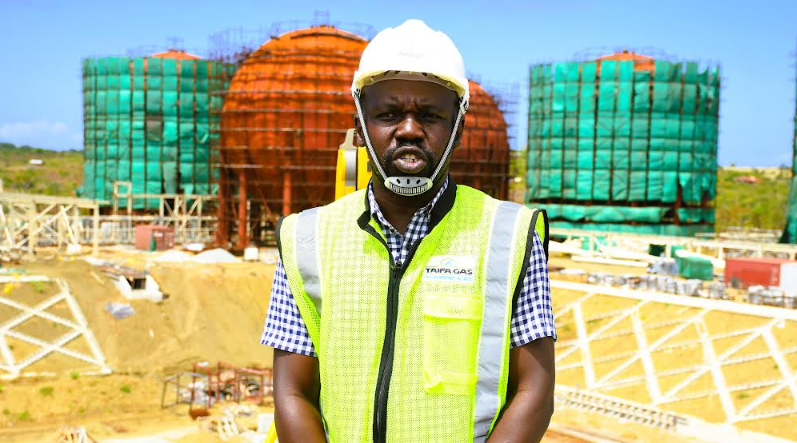
The Taifa Gas LPG Terminal at the Dongo Kundu Special Economic Zone in Mombasa is a massive energy project nearing completion with the new facility aiming to break a long-standing market monopoly, lower cooking gas prices, and turn Mombasa into a major East African LPG hub.
Observers say the new state-of-the-art gas terminal will strengthen Kenya’s LPG supply chain through efficient bulk importation, storage and distribution to markets across the country and beyond.
Taifa Gas Project Site Eng. Moses Ochieng said the project in the Dongo Kundu Special Economic Zone (SEZ) in Mombasa is a Liquefied Petroleum Gas (LPG) terminal and aligns with the government’s economic development blueprints and clean energy goals by scaling up regional cooking gas availability and driving down household energy costs.
Eng. Ochieng said developed on a 30-acre site approximately 4 km from the Port of Mombasa, the facility features 12 spherical storage tanks with a combined capacity of 30,000 metric tonnes with provisions for future expansion.
He said construction of the storage tanks is complete with testing underway while installation of pipelines, electrical systems and instrumentation is progressing steadily.
“Once the facility is up and running our substantial storage capacity will enhance competition, reduce supply bottlenecks and drive down the cost of cooking gas for households and businesses,” he said.
Sherry Ariko who is in charge of the Government Delivery Unit (GDU) in the coastal region reaffirmed that the development projects in the region are within the plans of the government to enhance the quality of life in the country.
She said the coastal region is in the midst of an unprecedented infrastructure transformation that will fundamentally reshape its landscape courtesy of the government’s transformative development agenda.
Ariko said the government will take the necessary efforts to implement the strategic mega infrastructure projects according to the highest quality standards and that they are fully completed and in good condition.
She said the government is hopeful that the infrastructure projects would reduce poverty levels while simultaneously stimulating economic growth through sustained economic expansion.
“The overarching objective of the multibillion shillings projects is to foster improved livelihoods through accelerated socio-economic transformation,” she said.
By Hussein Abdullahi