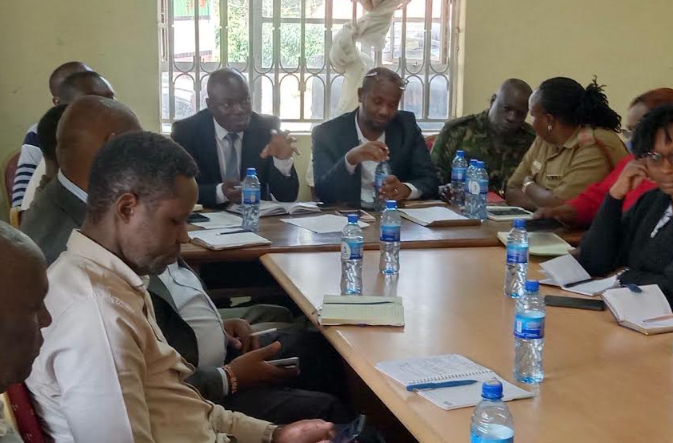
The County Government of Nakuru has assured residents that it is fully prepared to respond to the anticipated El Niño rains expected between October and December, saying comprehensive measures are already underway to minimize disruption and safeguard lives.
According to County Executive Committee Member (CECM) for Infrastructure, Engineer Michael Kamau, the devolved unit’s administration is working with all relevant ministries, departments, state agencies, and humanitarian agencies following forecasts indicating a high probability of above-normal rains later this year.
Engineer Kamau said they were prioritizing measures to prevent flooding, landslides, and mudslides while ensuring uninterrupted movement of people, goods, and services and protecting public health.
Speaking during a meeting between the county government’s Department of Infrastructure and the Bahati Sub-County Disaster Management Committee, the CECM noted that among priority interventions is the unclogging of drainages, particularly in urban centers, to reduce the risk of destructive flooding.
He explained that the Bahati Sub-County multi-agency Disaster Management Committee, which will be chaired by the Deputy County Commissioner for Bahati, will work closely with the Kenya National Highways Authority’s (KeNHA) Regional Coordinator and the County Department of Infrastructure.
“The committee will also bring together key stakeholders, including Kenya Railways, Kenya Wildlife Service (KWS), KeNHA Corridor B, the Kenya Rural Roads Authority (KeRRA), the Kenya Urban Roads Authority (KURA), and the National Environment Management Authority (NEMA),” stated the CECM.
He added, “Through the joint efforts, the committee will oversee a range of measures aimed at mitigating the impact of the El Niño rains. These will include unblocking and clearing drainage systems, constructing and improving culverts, and implementing other interventions identified as necessary to protect residents and infrastructure from flooding and related risks.”
Other contingency plans according to Engineer Kamau include evacuation and shelter arrangements for vulnerable communities, reinforcing roads and bridges prone to damage, pre-positioning emergency equipment and medical supplies, and issuing advisories to farmers.
He stated that the coordinated approach is intended to strengthen the county’s preparedness and ensure all agencies respond swiftly should the anticipated heavy rains occur.
Meteorological experts have warned that Kenya is among 22 countries worldwide that could experience significant impacts from a strengthening El Niño phenomenon expected to develop in the coming months.
Acting Director of Meteorological Services Edward Muriuki said although there is an 80 to 82 per cent chance that El Niño conditions will be in place during June, July, and August, these three months will be dry in most parts of Kenya, while western Kenya will have depressed rainfall.
He said the enhanced rainfall, common during El Niño, would occur during the October, November, and December seasons.
He explained El Niño does not influence the weather in Kenya in isolation. “KMD is also closely monitoring the Indian Ocean Dipole (IOD) signal, which modulates the effect of El Niño in Kenya,” he said.
The IOD measures the difference in sea surface temperatures between the western (Kenyan side) and eastern tropical Indian Ocean.
When the western side of the Indian Ocean is warmer than the eastern side, a positive IOD occurs—and this is historically linked to heavy rains in Kenya during the October-November-December season.
A negative IOD, on the other hand, tends to suppress rains in Kenya.
The IOD is currently neutral, and most models indicate it is likely to remain neutral in June 2026, with a positive IOD event possible later in the year.
“The combined effects of El Niño and a positive IOD significantly influence rainfall patterns over Kenya, potentially leading to enhanced rainfall during the October-November-December season. Updates on El Niño and IOD conditions will continue to be provided at monthly timescales or when required,” Muriuki said.
In a detailed weather forecast for the June-July-August forecast, Muriuki pointed to near-average to below-average rainfall across the Highlands West of the Rift Valley, the Lake Victoria Basin, the Rift Valley, and Northwestern Kenya.
Engineer Kamau said the country had previously suffered devastating consequences from flooding and should not ignore early warnings from experts.
In Kenya, El Niño events have historically been linked to above-normal rainfall and flooding, particularly during the latter part of the year, prompting calls for early preparedness measures from both national and county governments.
By Jane Ngugi and Caroline Nyakio