In a quiet early morning, Felicia Mageto kneels gently among a row of flowers at Etaya Governor’s Park in Kisii town, tending to each plant carefully and turning the soil around the roots.
Mageto, a resident of the Nyambera area, says she has been tending to the trees and flowers inside the park after the county government began the journey to transform the notorious Nyambera dumpsite into a recreational park.
The 43-year-old is among hundreds of women and youth currently taking part in the beautification and maintenance of the park.
For her, this quiet ritual represents more than gardening; she has witnessed the transformation of the park from a dumpsite to a recreational facility where residents can meet, relax, and enjoy themselves.

For many years, the Nyambera dumpsite situated at the heart of Kisii town posed environmental and public health risks to the residents.
Every morning, marabou storks would be seen aggressively competing with waste pickers and street children for discarded organic waste among the huge pile of garbage.
The smoke and stench from the dumpsite exposed the residents in nearby schools, homes, and health facilities to toxins that could increase health risks among them.
Mageto recalls the dumpsite was an eyesore for the residents in the area, and the stench became unbearable, especially for the patients at the nearby health facility.
“This place used to be very dirty and a lot of waste was being dumped here, posing a health risk to the patients at the Kisii Teaching and Referral Hospital,” she says.
An independent research report (2020) by Kisii University researchers dubbed “Assessment Of The Concentration Of Selected Heavy Metals (Pb, Cu, Cd, Zn) In Soils Within The Nyambera Dumpsite” also noted the presence of toxic levels of heavy metals in air, land, and nearby water bodies.
The research published by Evans Okemwa, Obed Nyabaro, John Kituyi and Peter Mukenyi, cited that since River Nyakomisaro flows adjacent to the dumpsite, some lead was deposited at the banks when it was flooded, hence raising the concentrations in the river.
Efforts to relocate the dumpsite from Kisii Municipality bore no fruit, with the previous administrations citing inadequate land for the exercise.
Consequently, the National Environmental Complaints Committee (NECC) ordered the closure of the dumpsite in February 2022, after receiving numerous complaints from the public concerning the health risks.
Following the closure, the Kisii county government began implementing proposals contained in the Sustainable Waste Management Act, 2022, particularly on source segregation of waste and mechanisms for materials recovery.
According to Kisii Governor Simba Arati, the first intervention was to decommission Nyambera dumpsite after years of indiscriminate dumping.
“Working with the National Environment Management Authority (NEMA), we successfully decommissioned the site and, in its place, we have a beautiful green space for use by residents as a recreational park,” Arati says.
The Governor notes the initial attempt to relocate the dumpsite to Etora in Bobasi was resisted by the residents, similar to the Nyatieko area in Kitutu Chache South and other possible alternatives.
Etaya Governor’s Park, formerly Nyambera dumpsite, now offers more than a physical facelift as residents have a place where they can walk and rest.
The park, rehabilitated at a cost of Sh35 million, has also enabled residents like Mageto to earn an income and improve their livelihoods through their engagement as workers in charge of maintaining the facility.
Secondly, Arati adds that the county government had set up a Material Recovery Facility (MRF) at the Kisii Agricultural Training Centre with support from the UK government under the Sustainable Urban Economic Development (SUED) Programme.
The facility, he notes, is a first of its kind in the region and has the capacity to process 50 tonnes of waste per day and process 10 tonnes of organic waste in the Black Soldier Fly unit to produce protein-rich animal feed and organic fertilizer.
Notably, Kisii County generates an estimated 200 tonnes of waste per day with higher volumes recorded during market days, with an estimated 60 percent of the waste being organic.
“The MRF has a weighbridge that will help us collect data to inform policy decisions going forward and therefore, I call upon more investors to plug in and scale up other initiatives, including waste-to-energy, commercial composting of organic waste, paper manufacturing, and adding value to recyclables aggregated at the MRF in Kisii,” Aarti adds.
In order to boost efficiency in waste management and ensure a cleaner environment in the county, the governor says they also recently launched the ‘Kazi Mashinani’ programme where youth and women are contracted to conduct regular cleanups, unclog stormwater drains, and clear bushes across the county.
The county boss says the programme has yielded impressive results, especially in Kisii Municipality, which is clean.
He confirms that the county government has been recruiting about 2,000 men and women every month to work in the programme on a rotational basis and it is estimated that over 24,000 people will benefit from the ‘Kazi Mashinani’ programme, thus improving livelihoods.
Arati says they have also acquired modern waste management equipment and machinery, including truck-mounted skip loaders and color-coded bins, to aid in source segregation and safe transportation of waste.
The colour coded three bins include the green bin is used to dispose of organic waste, the black bin for general waste and the blue bin for recyclable waste.
The initiative is in line with the National Environment Management Authority’s approved colour coding scheme for waste management.
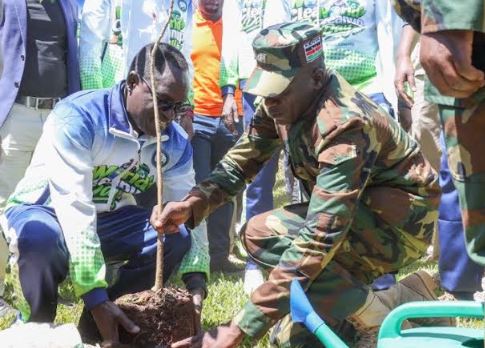
Based on the successful waste management efforts in the region, Kisii County was selected to host this year’s World Cleanup Day celebrations.
The event provided an opportunity an opportunity for the county to showcase its effort following the closure of its dumpsite and development of Material Recovery Facility (MRF) and sustainable waste management initiatives.
Speaking during the World Clean Up day celebrations at the Kisii Agricultural Training Centre on the outskirts of Kisii town, the Head of UN-Habitat for East and Horn of Africa Sub Region, Ishaku Maitumbi commended Governor Arati’s administration for the collective efforts aimed at promoting more sustainable regions with clean neighborhoods, including the green parks, public spaces and creating jobs for the young people.
“Municipalities and towns in Kenya generate approximately 0.3 to 0.45 tonnes of waste per day, with Kisii generating about 0.25 tonnes per day,” Maitumbi noted.
As such, he pointed out that improving the waste management system remains critical to protecting lives, strengthening communities, and building cities whose impacts are felt by everyone.
Maitumbi pledged to continue partnering with the county government of Kisii to promote sustainable initiatives and ensure no one is left behind.
Broadcasting and Telecommunications Principal Secretary Stephen Isaboke who attended the event, also urged the young people to utilize their energy to promote clean, safe and healthy cities and communities.
PS Isaboke challenged the young people to make environmental cleanliness a personal responsibility and encourage others to dispose of waste responsibly and separate waste where possible.
He also urged the youth to leverage social media to promote environmental awareness and address waste management and environmental challenges.
“There is an enormous potential for jobs, businesses, and innovation in areas such as recycling and waste management, and therefore, our young people should take advantage of such opportunities,” Isaboke added.
On his part, NEMA Director-General Dr. Mamo B. Mamo thanked Governor Arati for promoting peace and unity in efforts to improve cleanliness and environmental conservation in the county.
Dr. Mamo noted that Kisii had made immense progress in sustainable waste management and environmental conservation.
He also commended the workers under the Kazi Mashinani Programme for their efforts to keep the county clean and protect the environment.
Kisii County marked the World Cleanup Day 2026 celebrations on September 20 with residents, leaders, and environmental stakeholders taking part in a clean-up exercise at the Kisii Main Stage before culminating in a public gathering at the ATC grounds.
By Mercy Osongo