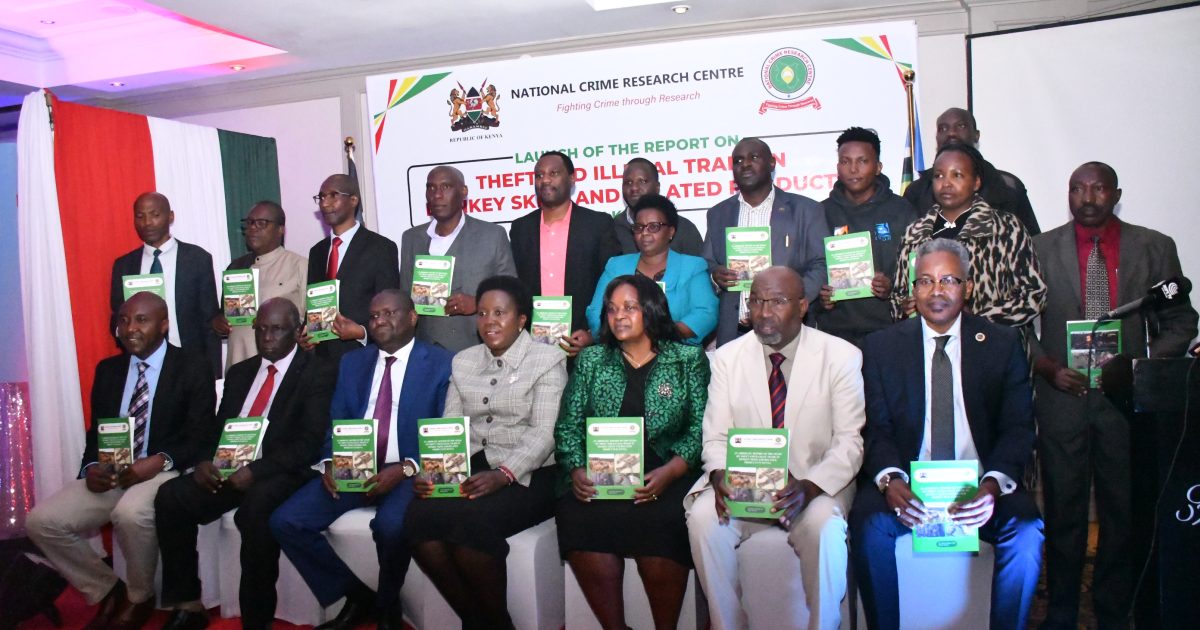
The Government has pledged to strengthen enforcement against donkey theft and the illegal trade in donkey skins following the release of a National Crime Research Centre (NCRC) Report exposing increasingly sophisticated criminal networks behind the illicit trade.
The Report dubbed ‘Theft and Illegal Trade in Donkey Skins and Related Products in Kenya’, launched, Thursday, in Nairobi, identifies donkey theft as an emerging security, socio-economic and public health challenge driven by international demand for donkey skins.
Principal Administrative Secretary (PAS) for National Administration, Beverly Opwora, who represented Principal Secretary for Internal Security and National Administration, Raymond Omollo, said the findings provide critical evidence to support stronger law enforcement, policy reforms and inter-agency collaboration.
Speaking during the launch at the Fairmont The Norfolk Hotel, Opwora said donkey theft has evolved from isolated livestock crime into organized criminal activity involving illegal slaughter, document fraud, clandestine transport and cross-border trafficking.
“The findings demonstrate that donkey theft and the illegal trade in donkey skins have evolved beyond ordinary livestock crime into a complex criminal enterprise with far-reaching socio-economic, security and public health implications,” she said.
She called for enhanced intelligence gathering, stronger border surveillance, increased community participation and closer regional cooperation to dismantle the criminal networks involved.
The Report, the first comprehensive national study on the subject, examined the scale, drivers and impacts of donkey theft across nine hotspot counties including Machakos, Kajiado, Mombasa, Embu, Kitui, Nakuru, Narok, Turkana and Kiambu. Researchers gathered information from 205 respondents, including livestock owners, law enforcement officers, veterinary officials, prosecutors, civil society organizations and community leaders.
According to the findings, theft has become increasingly organized, with syndicates targeting free-grazing donkeys, mainly at night, through networks comprising spotters, transporters, middlemen, illegal slaughter operators and buyers.
The Report also documents a sharp decline in Kenya’s donkey population, from about 1.8 million in 2009 to 1.1 million in 2019, a loss of nearly 700,000 animals. Researchers attribute the decline largely to increased slaughter driven by demand for donkey skins used in the manufacture of ‘ejiao’, a traditional gelatin-based medicinal and cosmetic product.
NCRC Director and Chief Executive Officer Dr. Mutuma Ruteere said the illegal trade continues to thrive because of sustained international demand and weaknesses in enforcement systems.
“The impacts extend beyond animal welfare to affect rural livelihoods, food security and community well-being. We hope these findings will inform evidence-based policies and stronger regional cooperation,” he said.
The report identifies Mwingi East, Mwingi Central, Kiambu, Machakos and Kajiado among the areas worst affected, with some counties recording more than 200 reported theft cases.
Researchers found that criminal syndicates have adopted sophisticated tactics to evade detection, including operating between midnight and 4am using reconnaissance teams to identify vulnerable households, poisoning guard dogs, conducting mobile bush slaughter and transporting skins through ‘panya routes’ using fast-moving vehicles.
Beyond livestock losses, the Report says donkey theft has disrupted livelihoods, reduced household incomes and deepened poverty, particularly in rural and arid areas where donkeys are essential for transporting water, farm produce and other goods. Women and children bear the greatest burden, often walking long distances to perform tasks previously undertaken by the animals, with some children missing school to assist their families.
National Assembly Committee on Administration and Internal Security Chairperson, Gabriel Tongoyo, welcomed the Report, saying it provides Parliament with an evidence-based framework for reviewing legislation and closing legal loopholes exploited by criminal syndicates.
“This Report provides the kind of evidence we need as legislators. It will greatly inform the review of existing laws and policies to strengthen the protection of animals, while ensuring those involved in these crimes face the full force of the law,” he said.
The findings are expected to inform future government policy, strengthen legislative reforms and reinforce efforts to protect Kenya’s donkey population and the livelihoods of thousands of households that depend on the animals.
By Grace Naishoo