Nandi County Government has partnered with the National Government and development partners in an effort to supply clean and reliable piped water to residents of Tinderet Sub County.
The initiative is under the ambitious last-mile water connectivity programme, in line with the County’s long-term development blueprint.
The initiative is also anchored within broader national water reforms and is also a key priority under the Nandi County Integrated Development Plan (CIDP) 2023–2027, which outlines an ambitious roadmap to achieving universal access to safe and clean water, expanding distribution networks and improving water storage and management systems across the county.
The County Executive Committee Member for environment and water resources Eng. Samuel Kibet, said the County government has aligned ongoing projects with the CIDP to ensure equitable access to water.
Under the CIDP, the county government targets increased household water connectivity, rehabilitation of existing water schemes, development of new water sources and strengthening of institutional capacity in water service delivery.
The plan further prioritises last-mile connectivity as a critical step in ensuring that investments in bulk water supply translate into tangible benefits for residents at the household level.
“As a county, we have prioritised water access as a basic need and a driver of economic growth, as clearly outlined in our CIDP 2023–2027. We are collaborating with the national government and development partners to ensure that once the bulk supply is in place, we move with speed to connect households,” said Kibet.
He noted that the county is also investing in complementary distribution lines and rehabilitation of existing water schemes to integrate them into the new system, in line with the CIDP’s objective of expanding and modernising water infrastructure.
A Public Benefit Organisation official, Anne Njoroge, said partnerships are critical in driving the project forward, particularly in mobilising resources and supporting community-level implementation.
Njoroge said: “Our role as partners is to complement government efforts by providing technical and financial support to ensure that projects like this are completed and are sustainable,” she said.
“We are encouraged by the progress made so far and the commitment demonstrated by all stakeholders, especially in aligning with long-term plans such as the CIDP.”
She added that the focus is not only on infrastructure development but also on strengthening local capacity to manage and maintain water systems effectively, a key pillar identified in the county’s development plan.
The project engineer overseeing the works in the sub-county, Eng. Peter Tanui, said the programme is progressing well, with pipeline installation and storage infrastructure works set to begin soon.
“We intend to lay extensive pipeline networks across various locations in the Sub County, as the main supply lines are already in place. At this stage, we are focusing on last-mile connections to households, schools and health facilities,” said Eng. Tanui.
He explained that the project includes construction of storage tanks, installation of distribution pipelines and metering systems to ensure efficient water supply, all of which are consistent with the CIDP’s emphasis on sustainable and efficient water systems.
According to Tanui, the final phase involves expanding connections deeper into villages and ensuring that water pressure is stable across all areas.
At the community level, residents have welcomed the ongoing efforts, describing it as long overdue and transformative.
In Chemursoi village, Mary Jepchirchir said the initiative has already brought hope to families that have struggled with water shortages for decades.
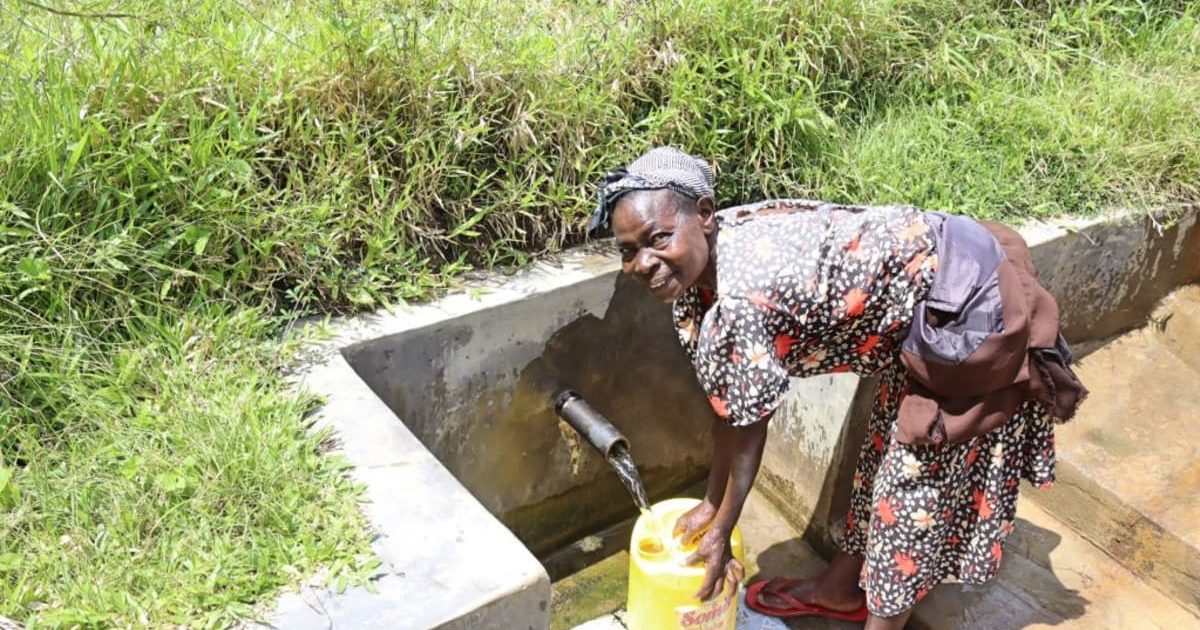
“We used to wake up very early and walk for long distances to fetch water from rivers and wells. Sometimes the water was not even clean,” she said. “Seeing these efforts gives us hope that soon we will have water close to our homes,” she said.
A local farmer, Kiprotich Langat, said the project is expected to improve both health and economic outcomes in the area.
“Our families have suffered from waterborne diseases because we relied on unsafe sources. With these efforts, we believe things will change for the better. We are grateful to the government and partners for remembering us,” said Langat.
He added that reliable water supply will also support farming activities, particularly small-scale irrigation and livestock keeping, which aligns with the CIDP’s broader goal of enhancing livelihoods through improved access to essential resources.
Community elder Joseph Ruto said the initiative has restored confidence among residents who had long felt neglected.
“This is something we have waited for many years. Even seeing the pipelines being laid is a sign that development is reaching us. We thank the government for these efforts,” he said.
At Kaplelimet and Kabikwen areas, residents reported that installation of storage tanks and pipelines is almost complete, raising optimism that full connectivity will soon be achieved.
A teacher at a local primary school, Beatrice Chepkemoi, said the project will significantly improve learning conditions once water is fully connected.
“Water is essential for sanitation and hygiene in schools. These efforts will help us maintain cleanliness and provide a better environment for our learners,” she said.
Health workers have also lauded the initiative, saying it will enhance service delivery in local health facilities.
According to Nurse Daniel Kiptoo, reliable water supply is critical in maintaining hygiene standards and preventing infections.
“In healthcare, water is indispensable. These efforts will go a long way in helping us improve the quality of services we offer,” he said.
Despite the progress, officials acknowledged challenges such as tough terrain and scattered homesteads, which would slow down connectivity in some areas.
However, they expressed confidence that the remaining work will be completed within the set timelines, in line with the CIDP implementation framework.
Kiptoo urged residents to support the project by safeguarding infrastructure and cooperating with implementation teams.
For residents who have long endured water scarcity, the initiative represents more than just infrastructure; it is a symbol of progress, dignity and hope.
By Sammy Mwibanda