More than 500,000 refugees living in Kenya’s Kakuma and Dadaab refugee camps have received a major boost after the Republic of Korea donated 10,000 metric tonnes of milled rice to the World Food Programme (WFP), easing fears of worsening hunger caused by deep funding cuts and shrinking food rations.
The humanitarian donation, valued at USD 9.53 million (approximately Sh 1.2 billion), is expected to cushion vulnerable refugees, mainly from Somalia, South Sudan, and the Democratic Republic of the Congo, who have been severely affected by reductions in international humanitarian assistance.
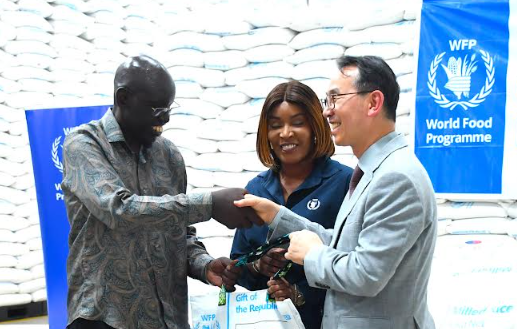
The Principal Secretary (PS) for Immigration and Citizen Services, Dr. Belio Kipsang, officiated the handover ceremony of the rice consignment from the Republic of Korea to the WFP in Mombasa.
He described the donation as a powerful demonstration of international solidarity and shared responsibility toward some of the world’s most vulnerable populations.
“This generous contribution will help sustain nearly half a million refugees in Dadaab and Kakuma during a period of immense humanitarian need,” said Dr. Kipsang, while commending the Republic of Korea for its unwavering generosity and enduring friendship.
The PS noted that since 2018, Korea has contributed more than 132,000 metric tonnes of rice to refugees in Kenya through the WFP, underscoring the country’s consistent commitment to humanitarian values, global responsibility, and the protection of vulnerable communities.
“Although this year’s contribution is lower than the 23,000 metric tonnes, valued at USD 19.9 million, that Korea generously provided in 2025, we recognize that the global humanitarian landscape is under tremendous strain,” he said.
“We, therefore, particularly appreciate Korea’s continued support at a time when humanitarian resources are increasingly constrained, even as needs continue to grow.”
Dr. Kipsang reaffirmed that Kenya has, for decades, remained a haven for people fleeing conflict, persecution, and instability across the region. He said the country continues to uphold its international and regional obligations under refugee protection and human rights frameworks, guided by its longstanding tradition of hospitality, humanity, and solidarity.
He observed that humanitarian needs have reached unprecedented levels due to funding constraints, forcing humanitarian agencies to slash food rations and leaving many refugee households to make impossible choices simply to survive.
“Behind every statistic are families whose resilience is being tested each day: mothers foregoing meals so that their children can eat, vulnerable people skipping meals, and young people facing uncertain futures. These are not abstract figures. They represent real people whose dignity, health, and prospects depend on the choices that we make together,” he said.
The PS warned that without sustained support from partners such as the Republic of Korea and other donors, humanitarian agencies would be forced to make even tougher decisions, including further reducing already inadequate food rations or excluding some of the most vulnerable refugees from life-saving assistance.
He further highlighted the government’s implementation of the Shirika Plan, a bold national framework aimed at transforming refugee management from long-term humanitarian dependency into sustainable socio-economic inclusion, self-reliance, and shared development for both refugees and host communities.
According to Dr. Kipsang, the Shirika Plan seeks to ensure that refugees not only survive but also gain opportunities to become productive members of society through access to education, livelihoods, financial inclusion, infrastructure, and public services, while simultaneously improving opportunities for host communities.
“The transition from humanitarian assistance to self-reliance is a process, not an event. It requires stability, dignity, and the assurance that basic human needs are met. Adequate and predictable food assistance, therefore, remains the indispensable bridge between emergency response and durable solutions,” he said.
The Republic of Korea officially handed over the 10,000 metric tonnes of rice to the WFP during a ceremony held at the agency’s offices near the Port of Mombasa, in what officials described as a timely intervention to strengthen food assistance for refugees in Dadaab and Kakuma.
WFP Kenya Country Director Ms. Betty Ka said the consignment would sustain nearly half a million refugees in the coming months as humanitarian needs continue to rise amid persistent funding challenges.
“This shipment also highlights the value of strong partnerships across the humanitarian supply chain,” she said, applauding the collaboration between the Government of Kenya, the Kenya Ports Authority, the Kenya Bureau of Standards, and the WFP for ensuring the rice was received and cleared efficiently.
She added that the smooth clearance process had saved the WFP approximately USD 21,000, funds that would be redirected toward the early pre-positioning of food supplies ahead of the anticipated El Niño season, strengthening the agency’s preparedness and reducing operational risks for hundreds of thousands of families dependent on humanitarian assistance.
The Ambassador of the Republic of Korea to Kenya, Kang Hyung-shik, said the donation reflected a partnership founded on solidarity and inspired by Korea’s own remarkable transformation from the devastation of World War II and the Korean War into one of the world’s top ten economies and a leading global development partner.
He noted that Korea became the first former aid recipient to join the ranks of major donor nations in 2009 and reaffirmed his country’s commitment to expanding official development assistance and humanitarian support to refugees and vulnerable populations through partnerships with the WFP and other multilateral agencies.
By Sadik Hassan and Joan Kinuthia