Principal Secretary for Medical Services, Dr. Ouma Oluga, has called for Kenya and the United Kingdom to deepen their health partnership by shifting towards sustainable, country-led collaborations that strengthen health systems and improve patient outcomes.
Speaking during the Kenya–United Kingdom Health Alliance (KUKHA) 5th Anniversary Conference at King’s College London, Dr. Oluga said the Alliance has demonstrated the transformative impact of collaborative effort over the past five years through investments in specialised healthcare, cancer services, health workforce development, and research.
He cited key achievements under the partnership, including the establishment of PET-CT and molecular imaging capacity at Kenyatta University Teaching, Referral, and Research Hospital; the rollout of mobile endoscopy services for esophageal cancer screening in Meru and Nyeri counties; and the implementation of the Kenya–UK Breast Cancer Initiative in Kisii and Mombasa.
The collaboration has also trained more than 100 clinicians in oncology while advancing joint research and academic exchange programmes.
Looking ahead, Dr. Oluga said the next five years present an opportunity to build on these gains as Kenya undertakes sweeping health sector reforms aimed at creating a more integrated, resilient, and sustainable healthcare system.
He highlighted key government initiatives, including Taifa Care, the Social Health Authority, expanded primary and community healthcare, digital health transformation, the National Equipment Service Programme, and increased investment in health products and technologies to improve access to quality healthcare across the continuum of care.
The Principal Secretary noted that evolving global health financing trends require a new model of partnership built on shared responsibility, with countries leading the design, financing, and implementation of programmes aligned to national priorities.
“We must move towards partnerships that are country-led, co-designed, co-financed, and co-accountable, with investments focused on strengthening domestic capacity and delivering lasting impact,” Dr. Oluga said.
He identified transplantation, cancer care, clinical skills and simulation, antimicrobial stewardship, genomics and precision medicine, health leadership, research, and health industrialization, including local production of medicines, vaccines, and health technologies, as priority areas for expanded Kenya–UK collaboration.
Dr. Oluga also called for stronger coordination of partner support under a government-led health sector framework, supported by a common delivery scorecard to monitor commitments, measure results, and enhance accountability.
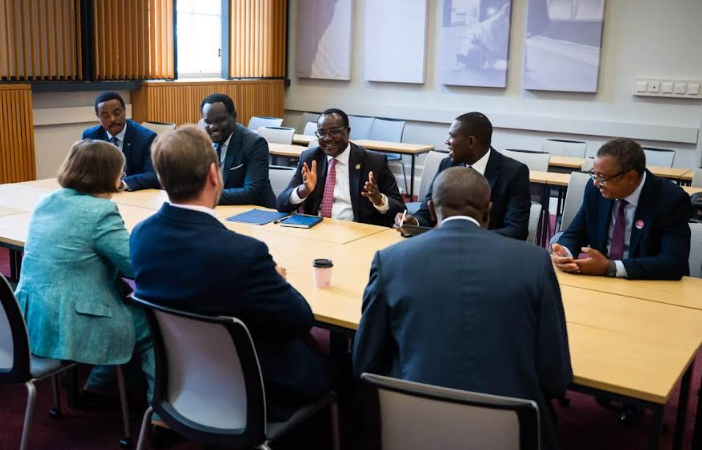
The two-day conference, held from July 27–28, 2026, under the theme “Working Together for Better Health for All,” has brought together senior government officials, universities, hospitals, research institutions, foundations, and private sector partners from Kenya and the United Kingdom to strengthen bilateral cooperation in health.
Among those attending were Cabinet Secretary for Education Julius Ogamba; the Chief Scientific Adviser from the UK Department of Health and Social Care; a representative of Kenya’s High Commissioner to the United Kingdom, Lord Crisp; the Vice-President and leadership of King’s College London; the KUKHA Secretariat and founding members; as well as representatives from universities, hospitals, research institutions, foundations, and companies from both countries.
By Joseph Ng’ang’a