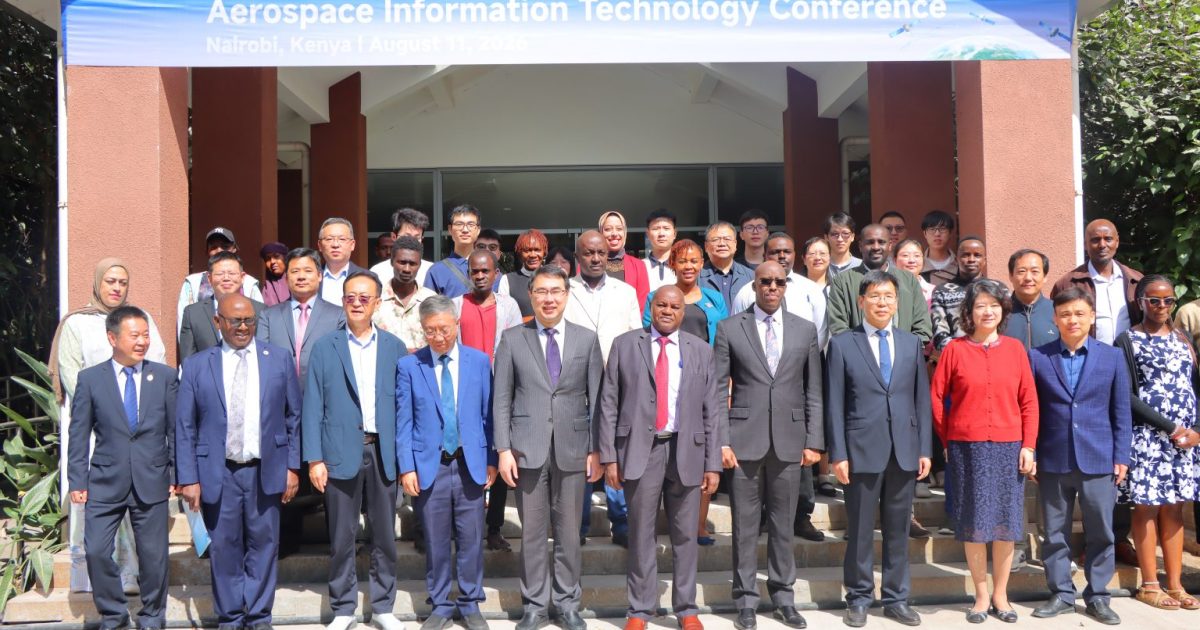
The 2026 China-Africa International Aerospace Information Technology Conference spotlighted how aerospace and information technologies are accelerating sustainable development across Africa.
Hosted at Jomo Kenyatta University of Agriculture and Technology (JKUAT) Sino-Africa Joint Research Centre (SAJOREC) on Thursday the event focused on leveraging cutting-edge technology to address key regional challenges.
The conference centered on leveraging aerospace information technology for regional growth, uniting government officials, researchers, and diplomats to advance bilateral cooperation across space tech, joint research, and digital innovation.
During his opening address, Deputy Vice Chancellor (RPE) Prof. Jackson Kwanza underscored the strategic duty of universities to lead research, innovation, and workforce preparation. He highlighted that academic institutions must actively equip the next generation with advanced skills to meet the demands of emerging sectors, including aerospace IT.
“I am Encouraged by the presence of young scholars and I urge every researcher present here to think creatively, embrace interdisciplinary teamwork in order to tackle society’s most pressing challenges through aerospace and tech innovation.’ Said Prof. Kwanza.
Welcoming attendees to the conference, SAJOREC Director Prof. Robert Gituru reaffirmed the university’s commitment to expanding student and researcher access to cutting-edge technologies. He highlighted Sino-African academic partnerships as vital engines for knowledge exchange, joint research, and technical innovation.
Prof. Gituru framed the partnership as a deep, mutually beneficial commitment to strengthening regional scientific capabilities. He noted that through faculty exchanges, technology transfers, and shared innovation hubs, Sino-African collaboration can generate sustainable solutions that serve both regions.
On his part while representing the Chinese Embassy, Minister Counsellor Zhang Zhizhong emphasized the strategic value of bilateral collaboration in science, technology, and innovation, reinforcing the need for deeper China-Africa cooperation in science and technology. He noted that aerospace IT offers reliable data and technical solutions to help African nations solve critical development challenges.
He underscored the need for Chinese and African institutions to share knowledge, expertise, and technical capabilities. Deeper partnerships, he noted, will help African nations leverage aerospace IT to solve practical, on-the-ground challenges and improve local livelihoods.
“Technologies like satellite remote sensing, GIS, and Earth observation hold immense potential for agriculture, disaster monitoring, and resource management. China remains committed to deepening technical cooperation with Africa and encouraging universities to build partnerships that drive joint research and innovation.” said Mr. Zhizhong.
Additionally, Maj. Gen. Hillary Kipkosgey, Director General of the Kenya Space Agency, emphasized the strategic role of space technology in advancing national development priorities. He highlighted remote sensing, satellite imaging, and spatial data tools as essential capabilities for effective environmental management, urban planning, and climate resilience.
“Governments must place greater emphasis on strengthening ties between universities, research centers, and international partners to build Africa’s space capabilities,” said Maj. Gen. Kipkosgey. “Space technology shouldn’t be seen as a domain for scientists alone as it is a vital tool for improving the lives of ordinary citizens.” He stated.
He further stressed the need to cultivate local talent by encouraging youth to pursue space science and STEM careers. Developing a skilled workforce, he noted, will empower African nations to build tailored solutions for homegrown challenges.
As Africa continues to confront pressing issues like climate change, food insecurity, and environmental degradation, conference participants agreed that aerospace information technology will play an increasingly vital role in driving sustainable solutions across the continent.
Ultimately, the conference proved that strong China-Africa technological ties can turn space-based data into actionable, community-level solutions for sustainable development.
By Hellen Lunalo