The Government has intensified preparations for the anticipated El Nino rains expected from October, with all 47 counties required to map flood-prone areas, identify safer evacuation grounds and put measures in place to protect lives, livelihoods and critical infrastructure.
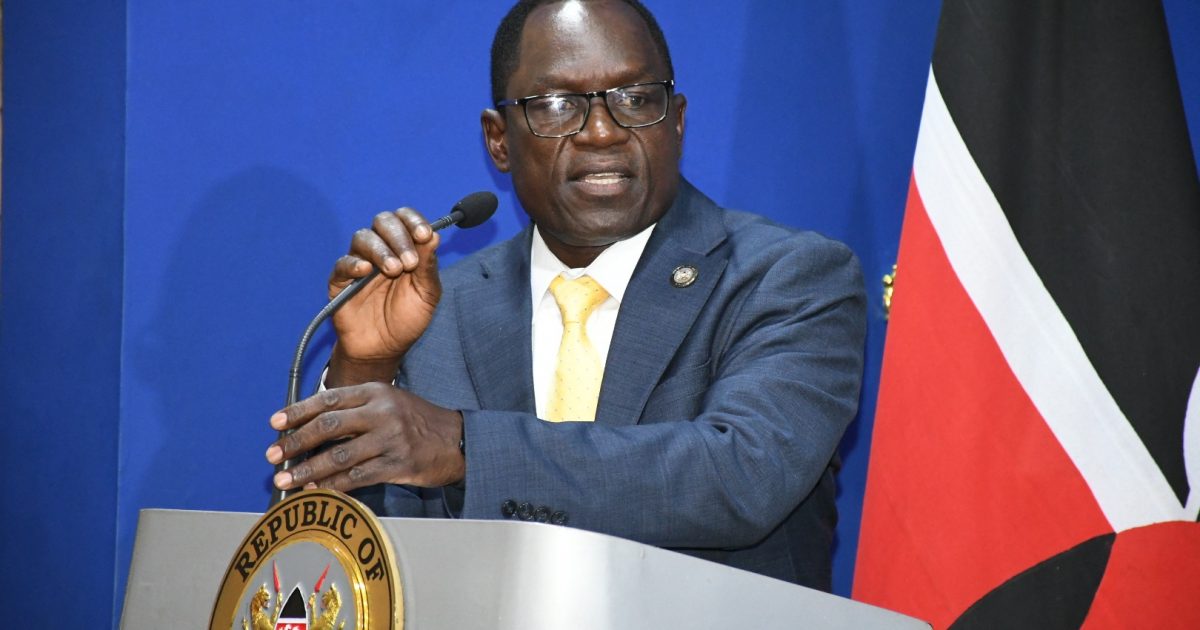
Principal Secretary for Broadcasting and Telecommunications, Stephen Isaboke, who chairs the National Crisis Communication Standing Committee, emphasised the importance of ensuring weather warnings translate into timely action.
The committee, established following the Cabinet approval of the communication policy, is expected to coordinate crisis messaging across ministries, departments and agencies and ensure information is accurate, timely and consistent.
Speaking during a multi-agency joint media briefing on the El Nino preparedness at Harambee Annex on Thursday, Isaboke noted that the Government will use mainstream and vernacular radio stations, digital platforms and national government administration structures to reach communities at the grassroots to avert loss of human lives and property.
“An accurate forecast, like what we are dealing with, or a technical advisory can only protect lives and livelihoods when it reaches the people who need it, in good time, through channels they can access, and in a form they can understand and act upon,” Isaboke said.
About 14 state departments are directly impacted by the anticipated rains, including roads, health, education, environment, special programmes and emergency response.
Isaboke called on the public to rely on verified information and respond promptly to official safety advisories.
“Stay informed. Prepare early. Follow official advisories. Act when advised to do so,” Isaboke reiterated.
Government Spokesperson, Charles Owino, said Kenya has a 90 per cent likelihood of experiencing above-average to very high rainfall during the October-November-December (OND) season, with the rains potentially projected to extend into early 2027.
Owino urged Kenyans to prepare early, remain alert and follow official advisories, while assuring the public there was no cause for panic because the government will be closely monitoring the events as they unfold.
“There’s no cause for panic. However, there is every reason for government institutions, communities and individual citizens to remain alert and take appropriate precautionary measures,” Owino said.
At the county level, Owino said county governments, working with national government administration officers, would map out areas of high risk and identify safer grounds for residents to take refuge especially those living along rivers and other hazardous locations.
“We will be prepared on all the 47 counties, and that is why every county government, with the help of our government administrative officers there, have to sit in their own committees and map out and then come up with a response strategy,” Owino said.
He explained that evacuation arrangements would vary from one county to another depending on local risks, with development and humanitarian partners expected to support preparedness and response efforts.
Owino further urged farmers and livestock keepers to take precautionary measures, including moving animals to safer and higher ground where necessary.
While increased rainfall could improve pasture in some arid and semi-arid areas, he cautioned that excessive rains could damage crops, livestock facilities, roads and other infrastructure.
The forecast comes as sea surface temperatures in the central and eastern Pacific Ocean stand at positive 2.7 according to the most recent forecast, a level associated with a strong El Niño event, while the Indian Ocean Dipole (IOD) remains neutral at positive 0.25.
Officials cautioned that a rise in the IOD above positive 0.4 could significantly increase the intensity of the expected rainfall.
Representing Principal Secretary for Environment and Climate Change, Dr. Eng. Festus Ng’eno, Ag. Director General Kenya Meteorological Services Authority, Edward Muriuki, explained that El Niño is not rainfall itself, but a climate phenomenon associated with unusually warm sea surface temperatures in the central and eastern Pacific Ocean that influence weather patterns globally.
Muriuki cited previous El Nino occurrences in 1997-98, 2015-16 and 2023-24 as examples, noting that the exceptionally heavy rains experienced in 1997-98 were compounded by a strong positive IOD.
“If the Indian Ocean Dipole does not enhance any further, we are likely to receive rainfall close to the 2015-2016 year,” Muriuki said.
Principal Secretary for Special Programmes, Ismail Maalim Madey, outlined a whole-of-government approach covering preparedness, response, recovery and resilience.
Madey disclosed that humanitarian supplies were being pre-positioned in counties to cushion communities against possible disruptions to livelihoods and transport, particularly in areas where flooding could damage roads.
“We have put together enough food that we feel will make sure all the 47 counties, if affected, will have enough support,” Madey said.
Basic Education Principal Secretary, John Lekakeny Ololtuaa, highlighted elaborate contingency measures the Ministry developed in response to anticipated heavy rains so as to minimize disruption of learning and administration of the national examinations in October and November.
The measures include mapping potentially high-risk areas, strengthening the school feeding programme and strategically positioning examination materials and containers in advance.
Ololtuaa assured parents and candidates that the government has put in place measures to ensure that the national examinations will proceed as scheduled despite the predicted El Niño rains.
By Nancy Omondi