The Judiciary has maintained that Kenya’s Supreme Court is more than just the country’s highest judicial body; it is the constitutional guardian of presidential elections.
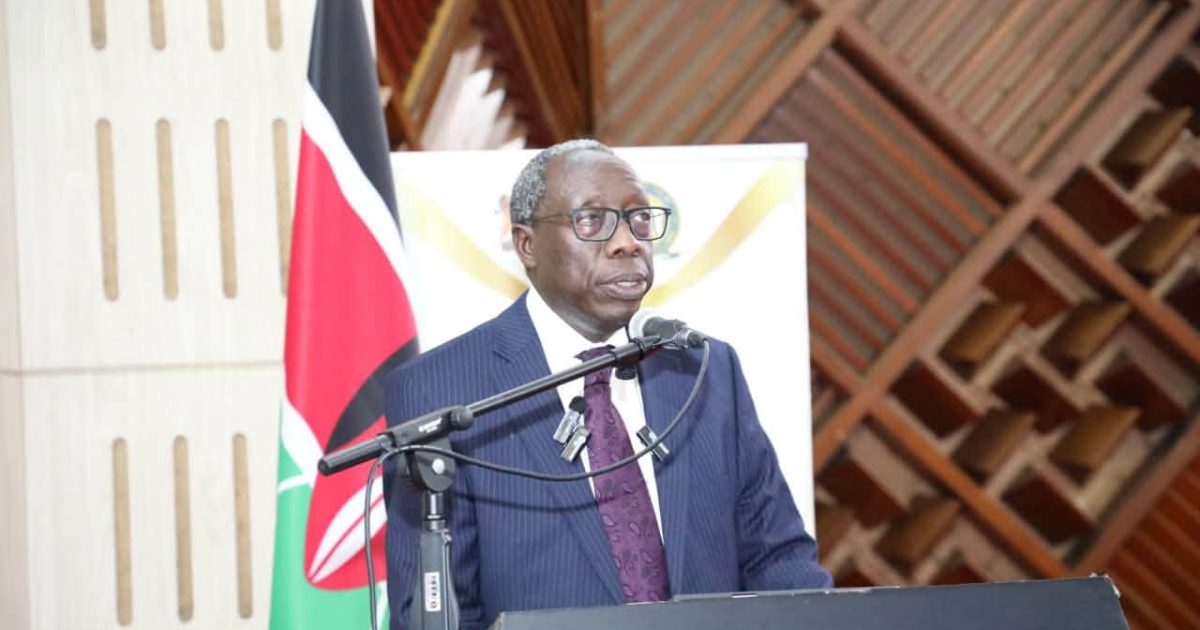
Speaking at the Catholic University of Eastern Africa (CUEA), Nairobi, during his Lecture Circuit Series 2026 themed ‘The Constitutional Architecture of Presidential Election Dispute Resolution in Kenya’, Supreme Court Judge Justice William Ouko underscored the Court’s pivotal role in safeguarding democracy by ensuring that disputes over the presidency are resolved swiftly, fairly, and with finality.
Justice Ouko traced the historical struggles that shaped this mandate and explained why the Constitution deliberately entrusted the Supreme Court with exclusive jurisdiction over presidential election petitions.
In retrospect, Justice Ouko traced the origins of this exclusive mandate to Kenya’s turbulent electoral history, particularly the contested elections of the 1990s and the violence that followed the 2007 polls.
He further recalled how the 1997 petition challenging the late former President Moi’s election was dismissed on a technicality, failure of personal service, highlighting the inadequacy of the old legal framework.
“The experience demonstrated the profound consequences that may arise where disputes concerning the exercise of political power cannot be resolved through institutions perceived to be credible, independent, impartial, and capable of delivering timely justice,” he noted.
The judge observed that the 2010 Constitution deliberately created the Supreme Court as the Apex judicial body, conferring upon it exclusive original jurisdiction over presidential election petitions under Article 163(3)(a).
According to Justice Ouko, this was not an accident of hierarchy but a conscious design to restore public confidence in the judiciary and safeguard the legitimacy of the presidency.
“Challenges to the presidential election require a forum possessing both constitutional authority and institutional finality,” he affirmed.
In addition, Justice Ouko pointed out that a distinctive feature of Kenya’s constitutional architecture is the strict timeline: He noted that petitions must be filed within seven days of the declaration of results, and the Supreme Court must deliver its judgement within fourteen days.
Consequently, Justice Ouko emphasized that this compressed framework is intended to ensure expeditious resolution and prevent prolonged uncertainty.
“Expedition must not be conflated with haste,” he cautioned, stressing the Court’s duty to balance speed with fairness and due process.
Turning to evidentiary principles, Justice Ouko explained that while the legal burden of proof rests on the petitioner, the evidential burden may shift depending on the strength of the evidence presented.
He cited the Supreme Court’s jurisprudence in Raila 2013 and Raila 2017, which established an intermediate standard of proof, higher than the civil threshold but lower than the criminal standard.
However, where allegations of electoral offences such as bribery are made, the criminal standard of ‘beyond reasonable doubt’ applies.
The lecture revisited the controversy surrounding Section 83 of the Elections Act. After the Supreme Court annulled the 2017 presidential election, Parliament amended the law to require petitioners to prove both constitutional non-compliance and substantial effect on results. The High Court later struck down the amendment, restoring the original ‘disjunctive’ test.
Justice Ouko established that this remains the applicable standard, reaffirmed by subsequent Supreme Court rulings.
Justice Ouko underscored that presidential election petitions are not ordinary civil disputes since they implicate the sovereign will of the people and the stability of the nation.
The Supreme Court’s role, he argued, is to ensure that even in the most contested elections, legitimacy is determined through law rather than political confrontation.
“The exclusive mandate of the Supreme Court must be viewed as part of the broader constitutional project of restoring public confidence in the judiciary and securing the peaceful transfer of power,” he urged.
Justice Ouko’s remarks mark the inaugural lecture of the Supreme Court Lecture Circuit Series 2026, launched as part of the Court’s ongoing educational outreach program.
By Michael Omondi