
The rich agricultural heritage of West Pokot has taken centre stage at the 2026 County Agricultural Show and Trade Fair, with farmers, agricultural experts, development partners and government officials calling for renewed investment in indigenous crops, as a pathway to food security and resilience against climate change.
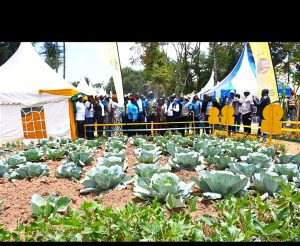
The three-day exhibition, held at Kishaunet Showground from September 24 to 26 brought together farmers, traders, exhibitors, agricultural institutions and development partners to showcase technologies, innovations and opportunities across the agricultural value chain.
The event was held under the theme: Promoting Climate Smart Agriculture and Trade Initiatives for Sustainable Economic Growth.
Governor Simon Kachapin officially opened the exhibition, accompanied by other county officials, BIBA Kenya and other stakeholders.
This was the first Indigenous Seed Fair in the county, which provided farmers with an opportunity to display, exchange and learn about seeds that have been preserved by communities for generations.
The fair also provided a platform for the launch of the West Pokot Agroecology Implementation Framework, supported by BIBA Kenya, which seeks to translate the county’s agroecology policy into practical interventions through stakeholder mapping, implementation and Monitoring, Evaluation and Learning.
Speaking during the opening ceremony, Kachapin said the future of agriculture in the county would largely depend on how farmers produce, value addition to their produce and access markets.
“The future of agriculture in West Pokot will depend not only on what we produce, but on how efficiently we produce it, what we do with it afterwards and the markets we can reach,” he said.
The Governor said the agricultural show had demonstrated that farmers were increasingly embracing new farming methods and technologies, aimed at improving production and efficiency.
He said the county government was particularly keen on agroecology and initiatives that promote farming systems suited to local conditions, while protecting the environment.
The importance of indigenous crops is particularly significant in West Pokot because of the county’s diverse ecological zones, stretching from the relatively high and cooler areas to the semi-arid and arid lowlands.
The diversity provides an opportunity for farmers to grow a range of crops suited to different climatic conditions rather than relying heavily on a single staple crop.
Kachapin noted that the county had experienced poor crop performance this year following inadequate rainfall, with maize, the main staple crop, expected to record low yields.
He said farmers were being encouraged to plant short-maturing crops to take advantage of anticipated El Niño rains and cushion themselves against food shortages.
The Governor added that he had engaged the Kenya Seed Company over the provision of varieties suitable for the lowland areas and capable of maturing within a short period.
“We must keep moving from production to productivity, from raw produce to greater value and from local potential to markets that can reward the work of our farmers,” Kachapin said.
He also highlighted county initiatives supporting farmers through the provision of perennial fruit seedlings, including mangoes, avocados and bananas, through county tree nurseries.
The emphasis on indigenous seeds was echoed by Anne Maina, National Coordinator of the Biodiversity and Biosafety Association of Kenya (BIBA Kenya), who thanked the county government for partnering with the organisation to support the seed fair.
Maina said the event had brought together representatives from different counties to showcase indigenous seeds and products covering both crop and livestock production.
She said the seed fair was not merely a celebration of traditional farming, but an important platform for conserving agricultural biodiversity and ensuring that farmers retain knowledge about seeds adapted to their local environments.
Maina noted that while the agroecology policy was launched last year, the implementation framework unveiled during the event provides a practical roadmap for putting the policy into action.
“The framework breaks down the process and provides a way through which agroecology can be achieved,” she said.
The initiative places farmers and communities at the centre of efforts to conserve biodiversity, promote sustainable food systems and strengthen resilience to changing weather patterns.
The presence of indigenous seeds at the exhibition also highlighted the importance of farmer-to-farmer exchange. Through sharing seeds, farmers can preserve varieties that might otherwise disappear, while maintaining knowledge passed down through generations.
The seeds also represent more than food production, with indigenous foods, traditional medicine and farming practices forming part of the cultural identity of communities.
The exhibition therefore provided an important bridge between traditional knowledge and modern agricultural innovations, allowing farmers to learn from one another while exploring new opportunities in agribusiness.
The County Executive for Agriculture Wilfred Long’uronyang had urged residents to attend the exhibition and take advantage of the training and knowledge-sharing sessions.
Long’uronyang said the show was intended to motivate residents to embrace agribusiness and contribute to the country’s food production and food security targets.
He encouraged farmers to move beyond subsistence production and explore agriculture as a viable business, particularly at a time when climate change is affecting traditional farming patterns.
The exhibition has also attracted international partners, including Marco Vinicio Vargas, The consul General, Embassy of Costa Rica who highlighted the need for farmers to adapt their production methods as climatic conditions continue to change.
He encouraged farmers to reconsider excessive reliance on manufactured fertilizers and explore organic farming and the use of manure, arguing that sustainable soil management was essential for long-term food production.
He said soil degradation and changes in soil composition could affect productivity and eventually increase farmers’ dependence on external inputs.
The agricultural trade fair has consequently become more than an exhibition of farm produce. It is a learning platform connecting farmers from the highlands, midlands and dry lowlands with technologies, markets and farming practices that can help them adapt to changing conditions.
For West Pokot, where agricultural production is closely tied to rainfall, the conservation of indigenous seeds could provide an additional layer of resilience.
As farmers displayed traditional grains, vegetables, fruits, livestock products and other agricultural products, the message emerging from Kishaunet was that food security will require a combination of indigenous knowledge, modern technology, climate-smart practices, value addition and reliable markets.
The just concluded 2026 Agricultural Show and Seed Fair therefore offered West Pokot an opportunity to showcase what its communities have preserved for generations, while creating space for new ideas that can strengthen agriculture and livelihoods in the years ahead.
By Parklea Ivor