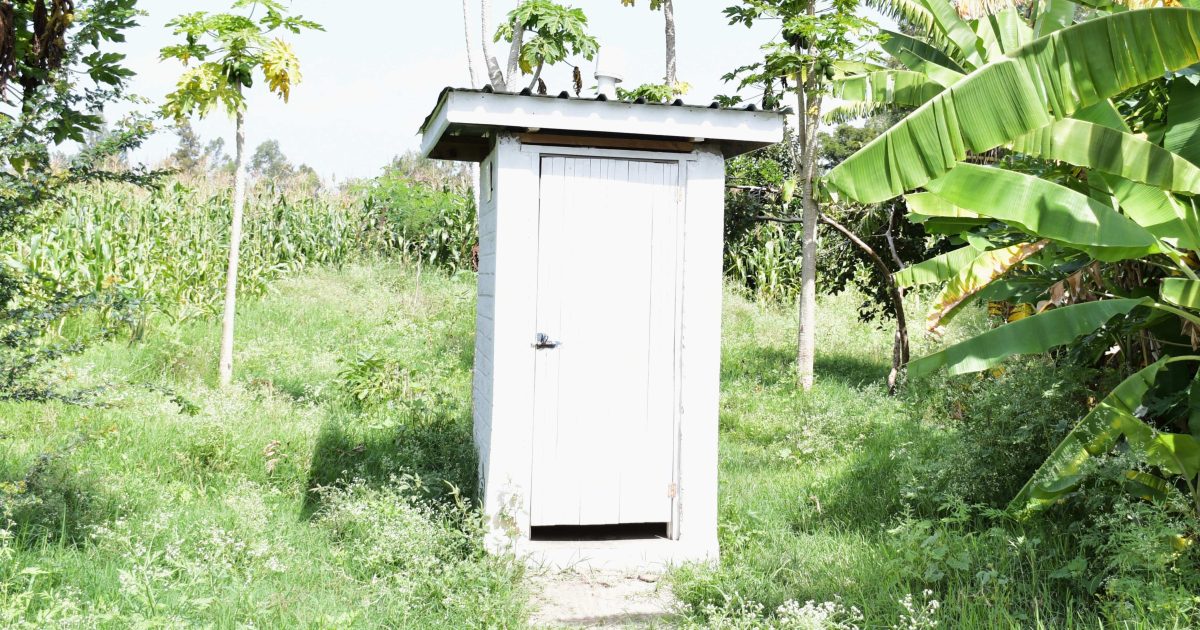
An innovative and affordable toilet has emerged as the go-to sanitation solution for residents in flood-prone areas in Nyando Sub-County, Kisumu County.
Michael Oguma is among the local artisans constructing the toilets at a cost of approximately Sh19,000 in Nyando Sub-County, Kisumu County.
Initially, the rainy season brought severe flooding to the area leaving a trail of destruction as homes were submerged, crops swept away, pit latrines collapsed and thousands of residents displaced.
The situation often exposed families to disease outbreaks, forcing residents to rebuild their toilets over and over again.
Traditional pit latrines often cost more in the long term due to repeated reconstruction after flooding, with households forced to rebuild several times each year.
Unlike the traditional toilets, these innovative latrines feature reinforced lined pits fitted with precast concrete rings, making them resilient to flooding and environmentally safe.
The design helps prevent collapse even during seasonal floods, ensuring safe, reliable, and dignified sanitation for communities.
“The toilet has become a lifesaver for the community, with many households admiring it and eager to construct similar facilities,” Oguma says.
Through the introduction of Safi Toilets in Kochogo location, Nyando Sub-County three years ago, households and communities are witnessing significant improvements in the quality of everyday life and public health.
The intervention, supported by Habitat for Humanity Kenya in collaboration with the County government, trained local artisans to construct 40 Safi Latrines serving over 250 vulnerable individuals in Kochogo South Sub-location.
The father and local artisan said the opportunity has completely changed his life his life, bringing about significant personal transformation.
“Before this program, life was difficult,” says Oguma. “The toilets we built could not survive the rains. Every flooding season people lost everything and had to start again.”
Oguma recalls, “People even resorted to digging temporary holes because they had nowhere safe to use. Cholera cases were very high during those days.”
But according to Oguma, things are now changing.
“Nowadays the community understands the importance of strong toilets,” he says. “When people see the new ones standing firm during floods, they ask us to build for them too.”
The project is doing more than improving sanitation.
By training local residents for free, Habitat for Humanity Kenya has created a new economic lifeline for artisans who previously struggled to find stable income.
Oguma says the skills he acquired are now helping him provide for his family.
“This work is feeding my family and educating my children,” he says. “I can now earn something from my own hands.”
Since the program began in 2023, local artisans have constructed more than 40 flood-resistant toilets across Nyando, including in churches and homesteads.
Oguma alone has helped build more than 10 units.
“Each toilet costs an estimated Sh.19,000 depending on materials and design specifications,” he noted, adding that challenges such as the high cost and scarcity of gravel and sand persist despite the growing demand.
“In a month we can get about three or four customers,” Oguma says. “People now trust these toilets because they last.”
The project is also strengthening dignity among vulnerable groups, especially women, girls, children, and the elderly, who are often hardest hit when sanitation systems fail during floods.
Earlier Community-Led Total Sanitation campaigns achieved up to 92 percent latrine coverage in Nyando Sub County, while the Safi Latrine initiative is now helping communities adapt to the growing impacts of climate change.
Experts say climate-resilient sanitation is becoming increasingly critical as extreme weather events continue to affect vulnerable regions across Kenya.
Water, Sanitation, and Hygiene (WASH) coordinator at Habitat for Humanity Kenya, Samwel Kapsali, said training local artisans not only enhances their technical skills but also creates job opportunities and promotes greater community ownership of the project.
“We transfer the technology through the training then they are able to cascade down to the community. Right now, around six churches and 16 households have privately done the resilient latrines,” Kapsali said.
Emma Oginga, the Nyando Sub-County Water Officer said the young men and women from the community were trained to ensure sustainability of the resilient latrines in the area.
“We have trained them on operations and maintenance so that we ensure sustainability and that a project of this capacity is not just there for a season,” Oginga said.
She added, “They were trained on how to construct pit latrines lined with precast concrete rings and how to build using trapezoidal blocks. Right now, with the skills they have acquired, they are even engaging in their own income-generating activities.”
by Robert Ojwang and Wendy Awuor