For more than three decades, Eunice Akinyi Ila, 53, lived with her family in Kagola East village, Nyando Sub-county of Kisumu County, under poor sanitation conditions.
The family of seven shared a simple mud-walled pit latrine for defecation and a makeshift space for bathing.
During the rainy season, the entire village is plunged into misery as the traditional pit toilets collapse due to flooding, contaminating water sources with raw sewage. Residents are therefore forced to depend on polluted water for drinking and domestic use.
“I invested in constructing seven toilets in the past after our family latrines were destroyed and swept away time and again as a result of the heavy downpour and flooding in the area,” Akinyi recounted.
The mother of five recalled the shame and embarrassment of hosting guests in their home and sending them to distant neighbours’ toilets when they needed to relieve themselves.
She lamented that the situation was dire, creating conditions ripe for disease outbreaks and infections.
“My children suffered from acute stomach ache and frequent diarrhoea because of wading through the water, which had mixed with toilet water. Sometimes they also fell victim to bouts of malaria,” Akinyi said.
Her husband, Gabriel Ila Okumu, 70, says the frequent floods have compounded their problems after floodwaters submerged and destroyed the family grass-thatched house.
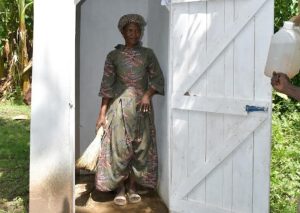
Okumu, who is visually impaired, says that he can no longer work or support rebuilding the family house.
“I suffer from blindness and cannot go to fetch grass to mend my roof every time and again. Whenever it rains, my family was left badly exposed to the downpour,” he said.
A neighbour, Jane Anyango Midi, who lives a hundred metres away, was left homeless after the recent flooding destroyed her mud-walled house.
The 72-year-old widow said she lived with the constant anxiety of being marooned and having her toilets washed away whenever it rained.
She says that in the last eight years, she has endured the burden of building more than eight latrines, which have all sunk due to the perennial floods in the area.
Recent heavy rains flooded the entire village and many people were displaced.
“The water flooded my home and rose higher than the windows of the house, destroying everything,” Jane recalls. “I was lucky to escape from the hut unhurt. Eventually, it collapsed.”
Sanitation issues like those faced by families of Anyango and Okumu are not isolated cases but a widespread problem across the flood-prone Nyando Sub-county.
The traditional pit latrines collapse time and again, polluting the environment and putting lives at risk, especially for women, girls, and the elderly.
According to the Ministry of Public Health and Sanitation 2025 data, 92 percent of families in Nyando Sub-county have access to proper toilets. That still leaves around eight (8) percent of families without adequate sanitation facilities.
Despite having been declared a 100 percent Open Defecation Free (ODF) area, frequent floods that destroy toilets have undermined the progress made.
The CECM Department of Medical Services, Public Health and Sanitation, Dr Gregory Ganda reported three deaths due to Cholera after 15 individuals were diagnosed with acute watery diarrhoea in Nyando Sub-county in March 2025.
The County government with its partners, plans to improve access to good toilets and sanitation from 33.1 percent to 70 percent by the year 2027 to eradicate open defecation in Kisumu’s rural sub-counties, which stands at 4.8 percent.
After years of struggle and despair, Akinyi, together with 40 other vulnerable families in Kochogo South Sub-location, Kochogo Location, finally had access to proper sanitation with the rollout of the Safi Latrines in 2023.
The intervention implemented by Habitat for Humanity Kenya and partners resulted in the construction of 40 flood-resilient toilets, dubbed the Safi Latrine, a sustainable sanitation solution specifically designed for unstable, flood-prone soils.
Her eyes welled with tears as she stood in front of the small white-coloured structure that now stood firmly in her backyard.
“I never imagined this would happen. This toilet is the first real help my family has ever received. We now live in safety and dignity, and our lives have greatly improved. I am truly grateful for the support,” Akinyi said.
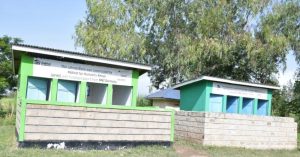
The family also received a one-bedroom house as part of the program targeting to empower the less fortunate.
“I was overjoyed to get this beautiful house and the new toilet. Now we can live and go to the toilet with dignity,” Okumu said.
Anyango says her family no longer lives in distress during the rainy season, as their new house and toilet have remained firm even during floods, restoring both their safety and her dignity within the community.
“I was so thankful. The new house and the toilet have changed everything. We now have peace of mind even when it rains and most importantly, there is no more shame,” Anyango added, her face glowing with joy.
Water, Sanitation, and Hygiene (WASH) Coordinator at Habitat for Humanity Kenya, Samwel Kiprop Kapsali, said the project targeted 4,000 people across 881 households spanning six villages within Kochogo South sub-location, aiming to cushion the community from the devastating effects of recurring drought and floods.
“The area lies close to the banks of the River Nyando, making it highly vulnerable to flooding whenever heavy rains cause the river to overflow. At the same time, the region also experiences prolonged dry spells, exposing residents to recurring drought and numerous other challenges,” Kapsali explained.
The Safi Latrines, he said, are designed to be flood-resilient, environmentally safe and culturally appropriate, constructed using locally available materials and incorporating community input with a focus to help prevent human waste from contaminating water sources.
The toilets feature reinforced lined pits fitted with precast concrete rings that significantly address sub-structural challenges and prevent collapse, even during seasonal floods, thereby promoting safe and dignified sanitation in some of the harshest environments.
“We do the normal pits then we put the concrete rings inside the pits to stabilize the walls. Then we do the slab. So whatever they put on the superstructure, the structure actually survives,” he stated.
The organisation trained local artisans and offered them employment opportunities and skills to build the model latrines and enable them to cascade down to the community.
“We transfer the technology through training local artisans and we are able to see a number of those resilient latrines in other places as well. Besides the 40 latrines that the project funded, around six churches have also built the Safi latrines,” Kapsali said.
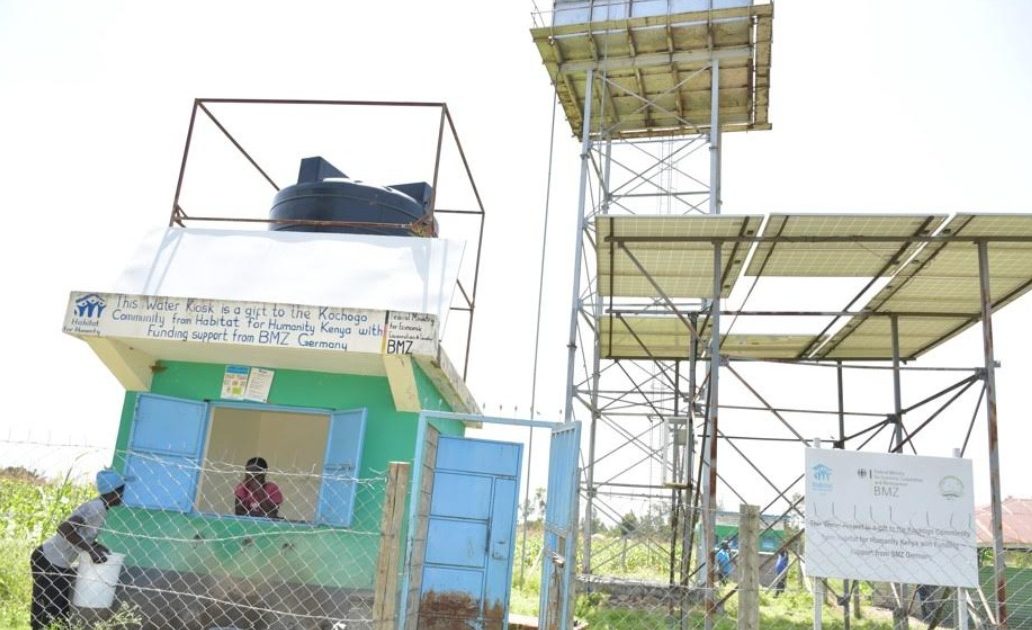
Further, he noted that through the Kochogo South CBO Water Project, a solar-powered borehole and six water kiosks have been set up serving the entire households in Kokech, Kagola, Kabongo East, Kabola West, Kaswa and Bwada villages.
Three learning institutions, including Nyomwaro Primary School, Disii Primary School and, by extension Disii Secondary School, now have safe sanitation and clean water.
Access to clean water in the region has long been limited by salty ground; however, Kapsali notes that the introduction of new technology has enabled the community to enjoy an unlimited supply of fresh water suitable for both human consumption and farming.
“During the drilling process, before casing, we sealed off the top aquifers, which contain a lot of saline water. This allows recharge only from the lower aquifers, resulting in fresh and safe water,” he explained.
Emma Oginga, the Nyando Sub-county Water Officer, hailed the program, saying it would strengthen sustainability in the provision of sanitation services within the community.
“During flood seasons, most of the pit latrines in the area do collapse, contaminating the water. So far, since we did the new pit latrines, none of them have collapsed. At least there is sustainability,” Oginga said.
She noted that access to safe water has contributed to improved public health, with the community now reporting fewer cases of water-related diseases.
“Waterborne diseases have reduced significantly in 2026. During the rainy seasons, we used to record at least 10 hospital admissions related to such illnesses. Ahero County Hospital even had a designated ward for these cases. However, this year, despite flooding after the rains, there have been no admissions so far,” Oginga said.
She emphasized that the County government and its partners have rolled out several interventions to ensure 100 percent access to clean and safe water as well as ensuring community members cover a shorter distance to the water points.
During the 12th National Climate Outlook Forum held in Nairobi in 2026, experts warned of possible flooding in parts of the Lake Victoria Basin and called for climate-resilient interventions, including improved sanitation systems, protection of water sources and strengthened community adaptation measures.
By Robert Ojwang’