The government has proposed a Sh64 billion allocation for the agricultural sector in the 2026/27 national budget.
This funding targets increased productivity, improved food security, and agricultural value chains, while protecting key sub-sectors from major spending cuts.
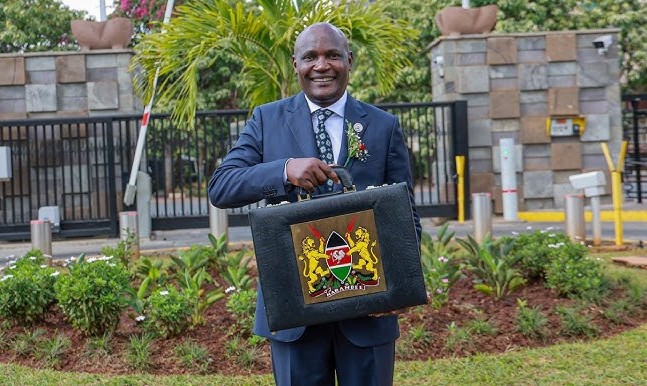
Presenting the budget policy highlights and revenue-raising measures for the financial year 2026/27 budget before the Parliament, National Treasury Cabinet Secretary John Mbadi said the government will continue supporting farmers through input financing, subsidies, and extension services aimed at boosting productivity and strengthening food security.
The CS noted that the Kenyan economy has remained resilient, recording an average growth rate of 5.0 percent between 2022 and 2025, outperforming the global average of 3.4 percent and Sub-Saharan Africa’s 4.1 percent over the same period.
He attributed the gains in part to interventions under the Bottom-Up Economic Transformation Agenda (BETA), which has driven notable improvements in the agriculture sector, including reduced fertilizer costs, increased agricultural output, expanded food security programmes, and strengthened farmer support services.
Under the fertilizer subsidy programme, disbursements rose sharply to 21.3 million bags in 2025 from 1.4 million bags in 2022.
During the same period, the price of a 50-kilogram bag of fertilizer dropped from Sh. 7,500 to Sh. 2,500, resulting in estimated farmer savings of about Sh. 105 billion over two years.
Agricultural production also recorded significant growth, with maize production nearly doubling to 67 million bags in 2025 from 34 million bags in 2022, while imports declined from 9.9 million to 3.3 million bags, reflecting improved domestic supply.
The CS noted that this increase contributed to a drop in maize flour prices, with a 2-kilogram packet reducing from an average of Sh. 250 to Sh. 165.
Rice production rose to 303,724 metric tonnes in 2025 from 192,299 metric tonnes in 2022, supported by the expansion of irrigation under public schemes, where acreage increased from 48,324 to 71,624 acres.
Potato production grew to 2.5 million tonnes from 1.8 million tonnes, while milk production increased to 5.52 billion litres from 4.60 billion litres over the same period.
Mbadi added that performance across other value chains also improved, with tea production increasing to 550.4 million kilograms in 2025 from 535.04 million kilograms in 2022, with export earnings rising to Sh. 187.1 billion from Sh. 163.3 billion.
In the coffee sector, the government distributed millions of seedlings to support rehabilitation and expansion of acreage, including 85,000 seedlings in 2023/24, 809,710 in 2024/25, 3.12 million in 2025/26, and an additional 2.24 million during the March–May 2026 long rains season.
Consequently, coffee acreage increased to 115,500 hectares in 2025 from 109,385 hectares in 2022.
The edible oils subsector also expanded significantly, with land under cultivation rising to 114,350 hectares in 2025 from 60,000 hectares in 2022, reflecting increased farmer participation.
In the sugar sector, interventions led to a 19.4 percent increase in cane cultivation area and a rise in national sugar production to 815,454 metric tonnes in 2024 from 472,773 metric tonnes in 2022.
Mbadi said that these gains have strengthened food security, reduced reliance on imports, stabilized food prices, and improved farmer incomes across key agricultural value chains.
At the same time, the CS proposed Sh. 4.9 billion towards the National Agricultural Value Chain Development Project, Sh. 5.4 billion to the Food Systems Resilience Project, and Sh. 1.6 billion towards the Food and Nutrition Security Programme.
Mbadi noted that the investments aim to strengthen adaptive livelihoods, diversify income sources, and reduce vulnerability to climate shocks.
In support of pastoralist communities, the government has earmarked Sh. 3.3 billion for the De-risking, Inclusion, and Value Enhancement of the Pastoralist Economy Programme. The Kenya Livestock Commercialization Programme will receive Sh. 1.3 billion, while Sh. 400 million has been set aside for the Livestock Value Chain Support Project.
The budget was being presented at a time of heightened global uncertainty arising from the ongoing conflict in the Middle East. The conflict has disrupted global commodity markets and supply chains, weakened investor confidence, and tightened financial conditions.
The CS, however, noted that despite the rising cost of living continuing to exert pressure on economic activities, new opportunities are emerging.
“The Kenyan economy has remained resilient and registered an average rate of 5.0 percent in the period 2022 to 2025, outperforming the average global growth rate of 3.4 percent and that of Sub-Saharan Africa of 4.1 percent,” he said.
The national budget for the 2026/27 financial year totals Sh. 4.8 trillion, and the CS projects an ordinary revenue collection of Sh. 3.6 trillion, leading to a fiscal deficit of Sh. 1.1 trillion.
The budget ran under the Theme: “Sustaining the Bottom-Up Economic Transformation Agenda for Resilient and Inclusive Growth amid Global Uncertainty.”
By Wangari Ndirangu