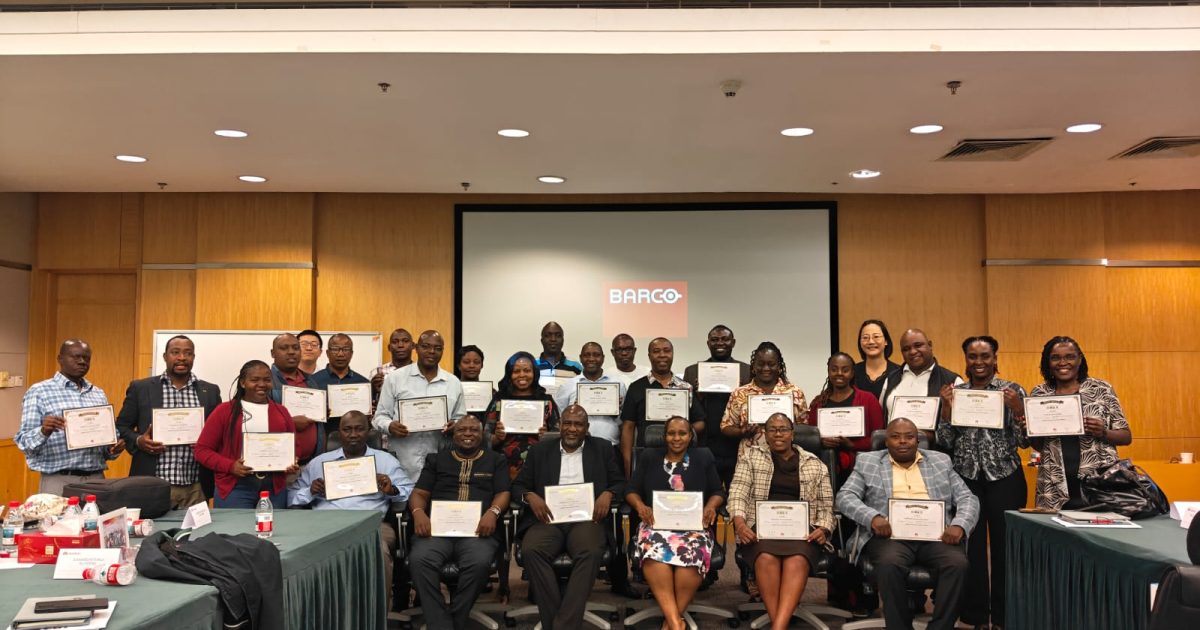
Kenya is deepening the capacity of its ICT leadership to harness Artificial Intelligence and other emerging technologies, following a week-long knowledge exchange programme in Shenzhen, China, that brought government ICT directors closer to the technologies, strategies and practices shaping the digital future.
Held from September 12 to 19, 2026, the programme was coordinated by the Ministry of Information, Communications and the Digital Economy (MICDE), through the State Department for ICT and the Digital Economy in partnership with Huawei Technologies.
The initiative builds on a series of local workshops and virtual training sessions conducted by the Ministry over the past financial year in collaboration with Huawei through the Technopolis Development Authority, with a focus on equipping government ICT officers with practical skills to support Kenya’s digital government agenda.
Speaking during the programme in Shenzhen, Secretary for ICT Security and Audit Control Emmanuel Kata thanked Huawei for the training and emphasised the growing importance of Artificial Intelligence in government.
“Artificial Intelligence is no longer a conversation about the future; it is already reshaping how governments plan, make decisions and deliver services to citizens. As ICT leaders, our responsibility is to ensure that Kenya does not merely adopt AI technologies but develops the capacity, governance frameworks and institutional readiness required to deploy them responsibly and effectively,” he said.
Acting Secretary for ICT, Digital Governance and Data Governance Bernard Rotich urged the directors to translate the knowledge and experiences gained into practical solutions that can strengthen digital government and improve service delivery in Kenya.
“The value of this exchange goes beyond the technology we are learning about here in Shenzhen. It is about understanding how innovation can be translated into practical solutions for our public institutions.
We must return to Kenya with ideas that can be adapted to our own context, strengthen digital public services, build institutional capacity and ultimately improve the experience of the citizen,” said Rotich.
Zhenyu Wang, Deputy Country Manager Huwawei Kenya welcomed the Kenyan delegation to Shenzhen and expressed appreciation for its participation in the knowledge exchange programme, noting the importance of continued collaboration in advancing digital transformation.
“It has been a great pleasure to host the Kenyan delegation in Shenzhen. We appreciate your commitment to learning, sharing experiences and exploring how emerging technologies, particularly Artificial Intelligence, can contribute to public sector transformation. We hope the knowledge and experiences gained here will provide useful insights that can be adapted to Kenya’s digital transformation journey,” he said.
The programme brought together ICT Directors and Deputy Directors drawn from a wide range of Ministries, State Departments and government agencies, including Lands and Physical Planning, ASALs and Regional Development, Transport, Youth Affairs and Creative Economy, Cooperatives, Crop Development, Blue Economy and Fisheries, the National Treasury, the eCitizen Directorate, Mining, Social Protection and Devolution.
The delegation also included the ICTA Deputy Director for eGovernment and an Assistant Director for Parliamentary Affairs.
Beyond classroom sessions, the training gave the Kenyan delegation an opportunity to see how technology, leadership, people and infrastructure can work together to drive continuous organisational and digital transformation.
The directors were taken through Huawei’s journey of continuous growth and business management, gaining insights into the strategies and practices that have supported the company’s evolution and culture of innovation.
They also visited the Shannon Exhibition Hall and Davidson Hall, where they were exposed to Huawei’s technological evolution and solutions. Sessions on human resource management further introduced them to Huawei’s management philosophy and practices, particularly approaches to developing and retaining talent in a rapidly changing technology environment.
The programme also explored China’s digital transformation experience, including Futian’s digital transformation initiatives, the National AI Strategy and industry practices, as well as practical applications of Artificial Intelligence across different sectors.
The delegation later visited the Guangzhou Artificial Intelligence Integration Empowerment Centre and a data centre showcase, gaining first hand exposure to the infrastructure and ecosystem that support the deployment of AI technologies at scale.
The exposure provided Kenya’s ICT leaders with a broader understanding of AI beyond its technical application, highlighting the importance of policy, skills, leadership, data, infrastructure and institutional readiness in determining how effectively emerging technologies can be integrated into government.
As Kenya continues to expand digital public services and strengthen the use of technology across government, the knowledge gained through the Shenzhen exchange offers an opportunity for the participating institutions to draw practical lessons and explore how AI and other emerging technologies can be responsibly adapted to the Kenyan context.
By Catherine Muindi and Ian Chepkuto