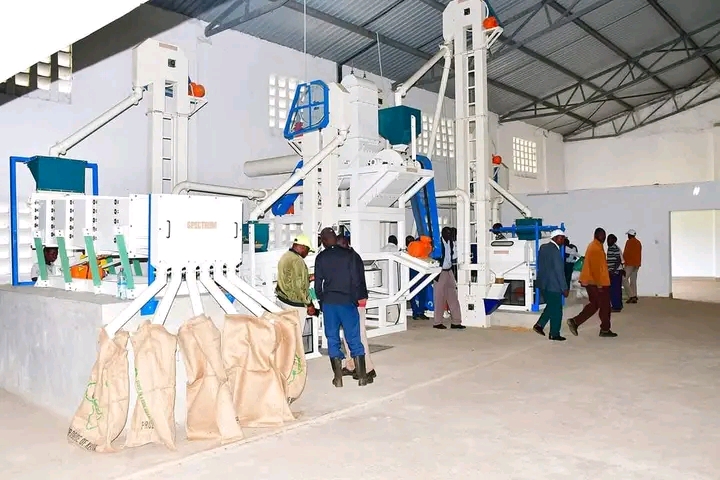
The Nandi Coffee Farmers’ Cooperative Union milling plant at Chebonet in Songhor-Soba Ward has emerged as the centerpiece of the coffee revival programme in Nandi County.
It is transforming the fortunes of thousands of smallholder farmers through value addition, improved marketing and cooperative development.
Standing strategically in Tinderet Sub County, the modern milling facility has ended decades of dependence on distant processors, enabling farmers to process their coffee closer to home while retaining more value within the county’s economy.
The Sh 60 million investment has strengthened the entire coffee value chain, from production and aggregation to milling, grading and marketing.
The establishment of the mill is part of the county government’s broader strategy to build a farmer-owned coffee industry anchored on strong cooperative societies rather than individual marketing.
The facility serves as the processing hub for the Nandi Coffee Cooperative Union, bringing together coffee from dozens of primary cooperative societies spread across the county.
County Executive Committee Member (CECM) for Agriculture and Livestock Development Dr Benard Lagat says the milling plant has fundamentally changed the structure of the coffee industry in Nandi.
“The Chebonet Coffee Mill is more than a processing facility. It is an economic empowerment project owned by farmers through their cooperative union. By processing our coffee locally, we retain value within Nandi, improve traceability, strengthen quality assurance and connect farmers directly to better-paying markets,” said Dr Lagat.
He said the facility receives coffee from primary cooperative societies spread across Tinderet, Aldai, Chesumei, Mosop, Nandi Hills and other coffee-growing parts of the county, making it the principal processing centre for Nandi coffee.
According to Dr Lagat, the mill was designed to support the rapid expansion of coffee farming that has seen thousands of farmers rehabilitate old plantations while many others establish new coffee fields following improved prices at the Nairobi Coffee Exchange.
The catchment area has continued expanding as more cooperative societies join the Nandi Coffee Cooperative Union, whose membership has grown from only 18 primary societies a few years ago to well over 100 organized societies today.
The CECM stated that the growth has been accompanied by a massive increase in coffee production. During the current marketing season, Nandi marketed more than 2.2 million kilogrammes of clean coffee valued at approximately Sh1.9 billion, placing the county among Kenya’s leading coffee-producing regions.
The Chebonet mill has played a critical role in this remarkable turnaround by ensuring that coffee is processed within the county before being marketed at the Nairobi Coffee Exchange.
Previously, farmers incurred significant transport costs while taking parchment coffee to processors outside the county, reducing their earnings and delaying payments. The local milling facility has greatly reduced these costs while improving efficiency and transparency.
The plant is equipped to undertake cleaning, grading, milling and preparation of export-quality coffee. Recent investments, including the installation of a modern weighbridge, have further enhanced accountability in coffee handling by ensuring accurate weighing and improved logistics for large deliveries from cooperative societies.
Dr Lagat noted that the county government continues to invest in additional infrastructure and equipment to increase the plant’s operational capacity as coffee production rises.
“We are preparing for the future because coffee acreage continues to expand every season. The milling plant has adequate room for expansion, and we are progressively investing in equipment that will ensure farmers continue receiving efficient services as volumes increase,” he said.
The county government has complemented the investment with aggressive distribution of certified coffee seedlings, extension services, farmer training and support for cooperative governance.
More than eight million coffee seedlings have been distributed across the county in recent years as part of an ambitious programme to restore Nandi’s position among Kenya’s premier coffee-growing counties.
The benefits have extended beyond the farmers.
Transporters now deliver coffee to a nearby processing facility instead of travelling long distances, creating savings on fuel and logistics costs.
Local youth have secured employment opportunities in coffee aggregation, transportation, milling operations, quality control and warehouse management.
Businesses around Chebonet trading centre have equally benefited from increased commercial activity generated by farmers, cooperative officials, transporters and buyers visiting the milling plant.
The revival has encouraged many young people to embrace coffee farming after years of regarding the crop as unprofitable.
Many farmers who had uprooted coffee bushes or abandoned plantations have since returned to the crop following improved prices and the availability of local processing services.
Dr Lagat attributed the transformation to deliberate policy decisions focusing on cooperative development and value addition rather than merely increasing production.
He said farmers are increasingly appreciating the importance of belonging to cooperative societies because collective marketing guarantees stronger bargaining power, lower operational costs and better access to extension services and farm inputs.
The county has also promoted improved agronomic practices aimed at increasing both productivity and bean quality.
This has seen Nandi County consistently produce premium grades, with nearly 80 per cent of its coffee classified as AA and AB grades, enabling farmers to earn attractive returns at the Nairobi Coffee Exchange.
The county government is now working with national agencies and development partners to further strengthen the coffee value chain through research, mechanisation and farmer capacity building.
He said plans are also underway to establish additional support infrastructure, including improved coffee pulping facilities and transport systems to complement the operations of the Chebonet milling plant.
Coffee industry stakeholders believe the success of the Chebonet mill demonstrates the importance of investing in farmer-owned value addition facilities.
Instead of exporting raw produce for processing elsewhere, the cooperative model ensures that a greater share of income remains with producers while stimulating rural economic growth.
For many farmers in Songhor-Soba ward and the wider Nandi County, the milling plant represents renewed hope after years of uncertainty in the coffee sector.
As more farmers plant coffee and existing growers expand acreage, the Chebonet Coffee Farmers’ Cooperative Union milling plant is expected to become an even more important pillar of the county’s agricultural economy, supporting higher production, improved quality, stronger cooperatives and increased household incomes.
Dr Lagat expressed confidence that continued investments in value addition, cooperative strengthening and market access will sustain the impressive growth witnessed in the sector.
“Our vision is to make Nandi one of Kenya’s leading coffee-producing counties through a fully integrated, farmer-owned value chain. The Coffee Mill is the foundation of that vision because it allows our farmers to capture more value from every kilogramme of coffee they produce. As production continues to rise, the benefits will spread across households, businesses and the entire county economy,” he said.
By Sammy Mwibanda