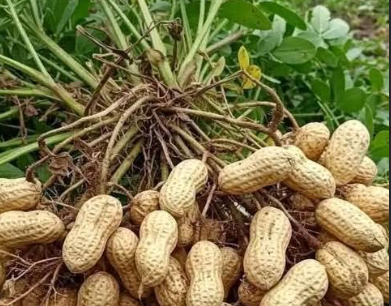
Agriculture experts in partnership with Egerton University have developed a new variety of peanut seed that is tipped to offer farmers improved crop production and increased incomes.
The new medium red variety known as ‘Mwangaza’ will be used to produce foods, manufacturing of oils, biofuels, and animal feeds. It takes 4-5 months to mature.
According to Principal Researcher Professor Paul Kimurto, peanuts were once doing well in Western Kenya, Nyanza, parts of the Rift Valley, and select zones in Eastern and Coastal regions, but their production dropped due to climate change and an increase in tropical diseases and pests that attack the crop.
“The seed variety has less aflatoxin after post-harvest and has the ability to withstand most tropical diseases and pests,” noted Professor Kimurto.
The seed has been developed by the University’s Agro-Science Park in collaboration with the International Crops Research Institute for the Semi-Arid Tropics (ICRISAT) through the Food Safety for Africa (FS4Africa) project with support from the European Union (EU).
In developing the ‘Mwangaza’ variety, the researchers have deployed a technology which produces proteins that are defensive against aflatoxin in groundnuts. By producing small proteins called defensins, the variety can stop the deadly fungus from propagating and infecting.
Other researchers include Dr. Milcah Wambua, Ms. Tracy Jayo, and Professor George Owuor.
Professor Kimurto indicated that laboratory analysis had established that the variety had recorded an 80 to 90 per cent reduction in aflatoxin accumulation.
The variety features a low aflatoxin level below 10 parts per billion (ppb). He stated that this is crucial because it strictly meets the safety thresholds enforced by the Kenya Bureau of Standards (KEBS) and European export markets.
The development, he added, could help farmers produce safer groundnuts while improving crop quality, yields, and market reliability.
Professor Kimurto said aflatoxin is a very acute public health issue affecting five billion people across the world.
Aflatoxin affects the food, feed, and market values of groundnut, resulting in severe economic losses to farmers and traders through market restrictions, low market values, and product rejection in the marketplace.
The principal researcher said the strength of the research was to tap into previous research to first stop seeds from being infected by the fungus and then prevent the fungus from producing aflatoxins.
“This will radically improve food safety and security in Kenya and the larger East African region. It will also avoid thousands of tons of fungi-affected crops being discarded every year or being consumed with unacceptable levels of the toxin,” he said.
Professor Kimurto explained that recent advances in biotechnologies, such as RNAi technology and genetic transformation, offer great potential in developing crops that can resist the infection and growth of the aflatoxin-producing fungus in the field and stop the production of aflatoxin itself.
Aflatoxins primarily afflict cereal grains, oilseeds, tree nuts, and spices that experience drought stress in the field or high moisture during storage.
These dangerous mold toxins are produced by Aspergillus fungi, mainly Aspergillus flavus and Aspergillus parasiticus. They pose a major risk to food security and public health in Kenya and the rest of the world.
The World Health Organization says high exposure to aflatoxins can cause acute poisoning and liver damage. It also outlines evidence linking aflatoxin exposure to liver cancer in humans.
The International Agency for Research on Cancer has similarly established the carcinogenic significance of aflatoxins and their association with liver cancer risk. Kenya has consequently developed regulatory standards for controlling aflatoxin contamination in food and feed.
Egerton University Deputy Vice-Chancellor-In-Charge of Academics, Research and Extension, Professor Bernard Aduda, said the institution was committed to ensuring research findings transition beyond laboratories and translate into practical solutions for communities.
Professor Aduda highlighted the university’s collaboration with the International Institute of Tropical Agriculture (IITA) and the Kenya Agricultural and Livestock Research Organization (KALRO), under FS4Africa, in developing high-yielding and resilient seed varieties as an important model for addressing food safety.
“The collaboration combines research, farmer training, extension, and evidence-based policy to tackle food safety risks across agricultural value chains,” said Professor Aduda.
Groundnuts are particularly important to Kenya’s smallholder farmers. The Kenya National Bureau of Statistics (KNBS) reports that the crop is mainly produced by small-scale farmers for household consumption, income generation, and supply to agro-processing industries.
However, national production remains below its potential. KNBS reported that groundnut production declined from 16,600 tonnes in 2023 to 13,300 tonnes in 2024, while the value of production fell from KSh3.1 billion Kenya shillings to KSh2.4 billion.
The decline was attributed partly to low productivity in major producing counties.
KNBS also identifies recycled seed, poor agronomic practices, and limited mechanization among constraints affecting groundnut productivity.
Professor Aduda indicated that the research team at Egerton was combining food safety with productivity and market considerations.
He pointed out that developing varieties that can withstand aflatoxin contamination could reduce losses while giving farmers more dependable produce for consumers and processors.
Kenya’s regulatory threshold for aflatoxin is 10 micrograms per kilogram for total aflatoxins and 5 micrograms per kilogram for aflatoxin B1.
The FS4Africa programme focuses on strengthening food safety systems through research, innovation, capacity building, and engagement with actors across food value chains.
The project has already supported farmer training on groundnut production and aflatoxin management in several Kenyan counties, including Elgeyo Marakwet, Meru, Baringo, Nakuru, and Siaya.
The training has covered agronomic practices, post-harvest management, and the use of Aflasafe as a biological control option.
Egerton’s work also involves participatory approaches that bring farmers into crop variety evaluation.
In earlier FS4Africa field activities, farmers participated in selecting varieties suited to their production conditions, while researchers trained them on harvesting, drying, and storage practices that can reduce contamination.
The university has also been strengthening technical capacity for detecting aflatoxins. The FS4Africa project has also organised training at Egerton University on aflatoxin and vitamin E analysis, bringing together 33 students, researchers, project partners, and industry representatives.
The research programme is also examining the nutritional quality of groundnuts.
According to Dr. Wambua, the Egerton-led work includes breeding varieties with high vitamin ‘E’ content and combining improved varieties with Aflasafe, good agronomic practices, post-harvest handling, and storage interventions.
She said the approach is significant because food safety risks can occur at several points between production and consumption.
“Safer varieties can therefore complement good harvesting, drying, storage, and marketing practices rather than replace them. Kenya’s experience with Aflasafe also demonstrates the potential of combining biological control with improved farming practices,” explained Dr. Wambua.
IITA and KALRO developed Aflasafe KE01 as a locally adapted biocontrol product, with field trials demonstrating substantial reductions in aflatoxin contamination.
Ms. Jayo said they were placing food safety within a broader development agenda, linking agricultural productivity, farmer incomes, public health, nutrition, and market access.
The agricultural research expert, biostatistician, and consultant in crop health stated that as Kenya seeks to increase agricultural productivity while improving the safety and quality of food reaching consumers, locally developed crop varieties and evidence-based production technologies could provide an important part of that transition.
Ms. Jayo pointed out that cereal samples in local Kenyan marketplaces frequently test exponentially higher than the country’s legal limit of 10 parts per billion (ppb)—sometimes reaching up to 500 ppb.
She added that when regulatory bodies like the Kenya Bureau of Standards (KEBS) flag these elevated toxins, major financial losses follow.
“Contaminated grains are heavily rejected by formal markets and millers, forcing smallholder farmers to sell their yields cheaply on informal markets or suffer total financial ruin. Resistant seeds ensure crops meet local and international standards, thereby preserving market competitiveness,” noted Ms. Jayo.
She observed that resistant seed varieties prevent massive quantities of staple food crops from being discarded annually, directly strengthening national food security.
Professor Owuor noted that aflatoxin causes major economic losses when contaminated grain is rejected by formal markets and sold cheaply in informal markets, while livestock can also die from contaminated feed.
He said once aflatoxin is present in grain, it cannot be completely removed by cooking, milling, or processing, making prevention at the development of seed and farm level critical.
Professor Owuor stated that developing and deploying aflatoxin-resistant varieties is the most sustainable and economic approach to control aflatoxin for human and animal well-being.
He indicated that groundnut has multiple economic values, serving as food, fodder, and cash income along the value chain.
“Groundnut kernels are often contaminated with pre- and post-harvest aflatoxins, which are major impediments to human and animal health and to economies along the value chains. The use of aflatoxin-resistant groundnut varieties is the most economically and environmentally friendly option,” elaborated Professor Owuor.
By Jefther Simeon Afuyo