National Defence University-Kenya (NDU-K) Vice-Chancellor (VC), Lt Gen David Tarus, has expressed fears that the information disorder was undermining public trust and posing risks to governance and national security of the country.
He urged the government to translate research findings on fake news, misinformation, and disinformation into concrete policies and coordinated action.
Lt. Gen. Tarus noted that the integrity of the information environment had become an important national security concern, as false and deliberately manipulated information can weaken confidence in public institutions, affect implementation of government policies, undermine social cohesion, and influence democratic processes.
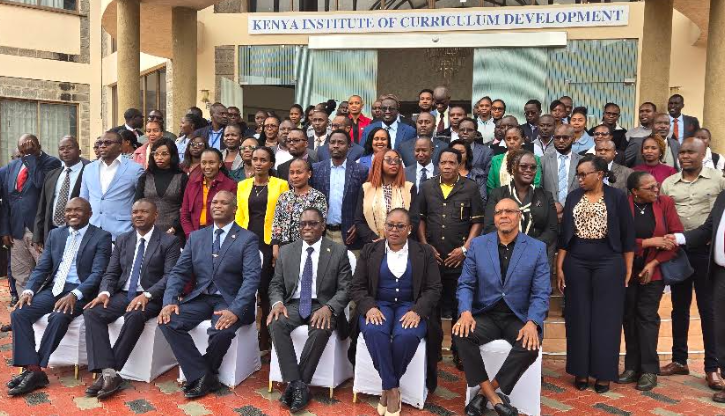
Tarus made the remarks Tuesday, 15th September, 2026, during the National Information and Public Communication Officers Sensitisation and Coordination Forum held at the Kenya Institute of Curriculum Development (KICD), Nairobi, where NDU-K presented findings and policy recommendations from its study on the place of fake news, misinformation, and disinformation in governance in Kenya.
The VC recalled that the studies on misinformation and disinformation and femicide were commissioned, following a directive by the President and Chancellor of NDU-K, during the university’s second graduation ceremony in November 2024.
He affirmed both studies had been completed, with their findings and policy briefs shared with relevant ministries and State Departments, and called on stakeholders to move from research to policy and from policy to implementation.
“NDU-K is ready to provide evidence, data, technical expertise, and intellectual support to help translate the recommendations into practical interventions,” Lt. Gen. Tarus assured.
The research, presented by University Registrar Dr. Stephen Nzioki Mailu, established that reliable information is central to effective governance and public trust, but fake news, misinformation, and disinformation can distort public understanding and weaken confidence in government.
Dr. Mailu said the study examined the drivers and transmission of false information, its impact on governance, the effectiveness of existing legal and governance frameworks, and interventions that could mitigate its negative effects.
He observed that social and digital media had become major channels for the spread of misleading information, including during the 2017 and 2022 general elections, when information was used to influence public opinion.
“The study recommends stronger institutional responses, public awareness, digital literacy, and improved government communication to address the negative effects of misinformation and disinformation,” Dr. Mailu stated.
Speaking at the event, Deputy University Librarian Dr. Dickens Rodrigues Wendo pointed out that gaps in government communication could create information vacuums that allow speculation and misleading narratives to take root.
Dr. Wendo called for stronger public communication, particularly by closing gaps between policy announcements and implementation, while engaging digital platforms to address harmful content without resorting to censorship.
He also proposed the use of technology and Artificial Intelligence to detect and analyse misinformation, disinformation, deepfakes, and coordinated bot activity.
“Public sensitisation should involve chiefs, local officials, and community forums,” he urged, noting that a whole-of-government and whole-of-society approach was necessary to address the challenge.
Concurrently, Research Fellow Dr. Raphael Ziro Mwatela outlined measures for operationalising the recommendations, including integrating government information across ministries, state departments, counties, public offices, broadcasters, and telecommunications actors.
Dr. Mwatela proposed that government agencies prepare frequently asked questions, myth-busters, and local-language information before announcing sensitive policies to enable officials to respond quickly to misleading narratives.
He recommended a phased six-month roadmap, beginning with the establishment of coordination structures and protocols, followed by piloting the approach on sensitive policies and eventual scaling up while monitoring its effectiveness.
“The response should protect public safety while respecting constitutional rights, privacy, media freedom, and lawful criticism,” Dr. Mwatela maintained.
Principal Secretary (PS) for Broadcasting and Telecommunications, Stephen Motari Isaboke, said government communication was being strengthened to improve public access to official information and rebuild trust.
Isaboke insisted that communication should be integrated into major government projects from the planning stage, with communication officers advising institutions on public messaging and crisis communication.
He equally mentioned that the government was working towards more coordinated communication across public institutions to ensure citizens receive timely and accurate information.
Meanwhile, the Forum, themed ‘Strengthening Coordinated, Proactive, and Responsive Government Communication’, brings together information and public communication officers to strengthen coordination and implementation of government communication policies and frameworks.
By Sharon Njeru