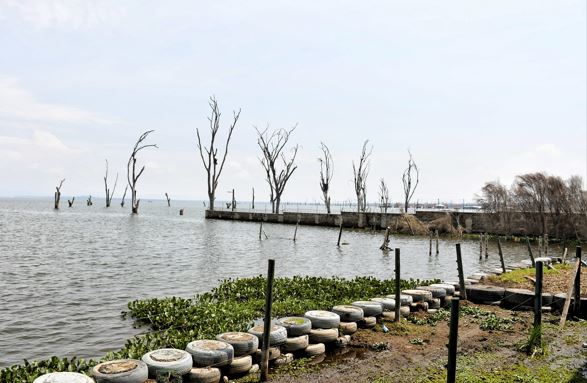
The Kenya Marine and Fisheries Research Institute (KMFRI) has partnered with fishermen to restore the degraded papyrus reeds along the Lake Naivasha shoreline, aiming to boost fish breeding sites, improve water quality, and curb pollution.
The project, funded by the World Wide Fund for Nature (WWF), targets the restoration of 30 acres, with an eventual goal of expanding papyrus cover by an additional 100 acres within the next two years.
According to Edna Waithaka, in charge of KMFRI Naivasha, the lake’s ecosystem has been adversely affected by the destruction of the papyrus, with waste and silt openly flowing into the lake.
“This weed is critical in protecting the lake from effluents from nearby estates, farms, and hotels, and thus the need to rejuvenate it so that we can stop serious forms of pollution,” she said.
Waithaka said fish landings had fallen sharply, from a peak of about 3,400 metric tonnes in 2019 to roughly 1,050 metric tonnes last year, with some of the fish species being depleted.
She attributed the decline to a combination of increased fishing pressure, illegal fishing, poor fishing practices, and the degradation of papyrus and other aquatic vegetation that sustain the lake’s food web.
Waithaka said about 70 percent of the lake’s papyrus cover had been lost over the past two decades to illegal cultivation, encroachment on riparian land, and use as livestock feed, leaving only scattered vegetation along parts of the shoreline.
She said the plant acts as a natural filter against effluents from nearby estates, farms, and hotels, and its loss had allowed waste and silt to flow unchecked into the lake, contributing to declining water quality.
“Papyrus are critical as nesting grounds for some birds and are also critical as breeding sites for fish,” Waithaka said, adding that restoring the vegetation would help re-establish a balance supporting fishers, birds, hippopotamuses, and other species dependent on the lake ecosystem.
On her part, KMFRI senior official Salima Otieno said papyrus was particularly important for fish breeding, as fish lay their eggs and attach them to the roots of the plant.
She said restoring the vegetation would support efforts to revive fish species whose populations have been severely reduced by disruption to the lake’s food web and called for reduced fishing pressure and the adoption of closed seasons to allow stocks time to regenerate.
Grace Nyambura, representing the Naivasha Oloiden Fishers Community Based Organisation (NAOFO), said the restoration idea originated with local fisher-folk after they observed an alarming drop in catches.
She said years of papyrus being burnt or cut down by pastoralists and private individuals had damaged both water quality and fish stocks, calling on multi-stakeholders to restore the lake and enhance sustainability.
Nyambura noted that the lake borders five of Naivasha’s eight wards, meaning a significant share of residents depend on it for their livelihoods, and that it remains under heavy pressure from illegal fishing.
Paul Ruoya of the Lake Naivasha Basin Landscape Association (LANABLA) said the lake also faced pressure from illegal logging in the upper catchment, warning that unchecked logging would have a significant future impact on downstream water levels.
Stakeholders said restoring Lake Naivasha should not be treated as a blame game but as a shared responsibility, requiring communities, government agencies, conservation bodies, and other lake users to work together.
By Erastus Gichohi and Orpah Gesare