The Busia County Government is closely working with key stakeholders in animal husbandry, FIPS Africa and the Kenya Animal Genetic Resources Centre (KAGRC), to expand dairy farming through subsidized artificial insemination (AI).
The initiative aims to produce high yielding breeds, climate-resilient, disease-resistant dairy cattle as well as increased milk production so as to improve farmers’ incomes.
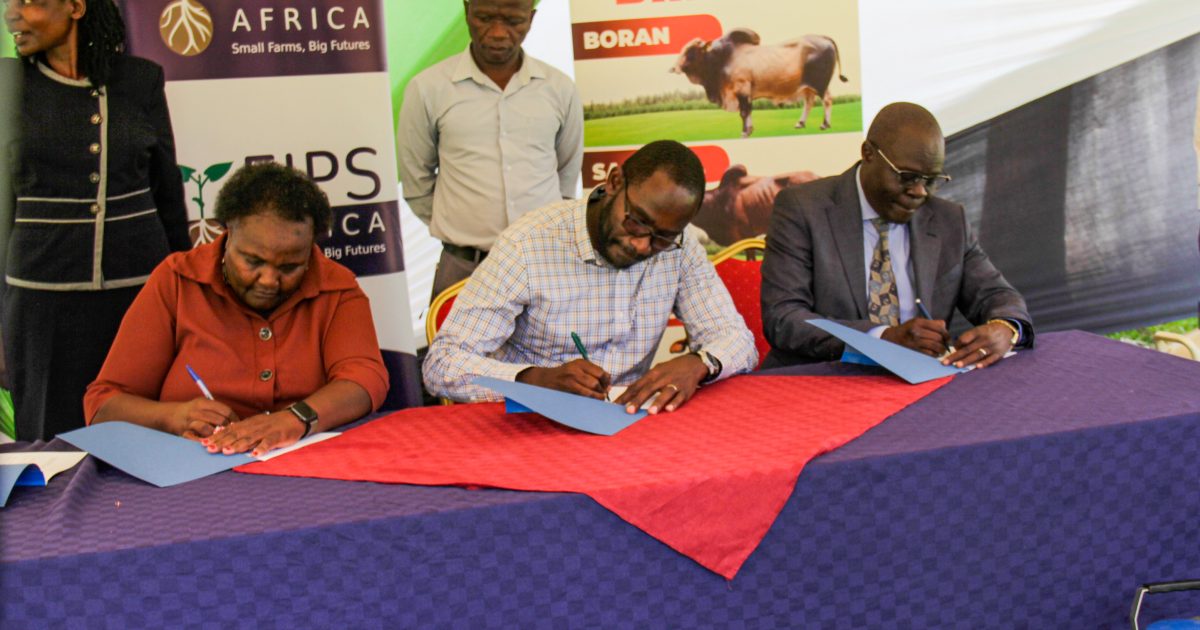
Speaking during the signing of the Memorandum of Understanding (MoU) in Busia on Monday, the County Executive Committee Member (CECM) for Agriculture, George Mukok, said the partnership will help farmers breed dairy cows that can withstand climate change while reducing the spread of diseases through natural breeding.
“We need to reduce disease transmission from bulls. Under this partnership, KAGRC will provide AI semen; FIPS Africa will conduct farmer training and capacity building, while the county government will oversee insemination through its service providers,” Mukok said.
Mukok noted that many farmers have suffered losses after buying cows from other regions that failed to adapt to Busia’s climate, adding that the programme will instead focus on improving local breeds that are already adapted to the area’s conditions.
He announced that the cost of AI semen will be reduced from Sh2,000 to Sh700, making the service more affordable for farmers.
“I urge farmers to take advantage of this opportunity to improve milk production. We also want to breed cows that are resistant to diseases and harsh weather conditions,” he said.
The CECM encouraged farmers to embrace dairy farming as a business, noting that shrinking land sizes make it impractical to keep large herds.
“It is better to keep one cow producing 40 litres of milk than 20 cows producing only 10 litres. We are also distributing pasture seeds to help farmers access quality animal feeds,” he added.
FIPS Africa Partnership and Technical Manager Raymond Kojo said the programme seeks to improve dairy productivity by making AI services affordable.
“The partnership has subsidized AI services to Sh700 per farmer. We are targeting more than 6,000 inseminations across Busia, Bungoma, and Kakamega counties, with at least 2,000 to be carried out in Busia,” Kojo said.
Kojo said the project aims to help farmers increase both the quantity and quality of milk produced.
“We want farmers whose local cows currently produce between half a litre and one litre of milk daily to increase production to at least five litres. This could earn them a minimum monthly income of Sh10,000 and improve their competitiveness in the dairy sector,” he said.
Kenya Animal Genetic Resources Centre (KAGRC) representative Lilian Naliaka encouraged farmers to adopt improved breeds with higher milk and meat production.
“We want farmers to keep cows that produce more milk and better-quality meat than the traditional breeds. We will introduce improved breeds with higher productivity,” she said.
Naliaka also said KAGRC will provide sexed semen, enabling farmers to produce more female calves for dairy farming.
“We are also encouraging farmers to join SACCOs so they can access grants and other government support programmes,” she added.
Farmers led by Daniel Ayuka said poor access to semen and inadequate cold-chain facilities had reduced the success rate of artificial insemination.
“Many of our cows failed to conceive because the semen was not properly preserved before insemination. This programme will improve access to quality semen and reliable AI services,” he said.
Ayuka said the initiative will help farmers replace low-producing cattle with improved breeds.
“I currently produce about 70 litres of milk from nine cows, but demand in Busia remains high. Artificial insemination will help us improve our breeds and significantly increase milk production,” he said.
By Salome Alwanda and Rodgers Omondi