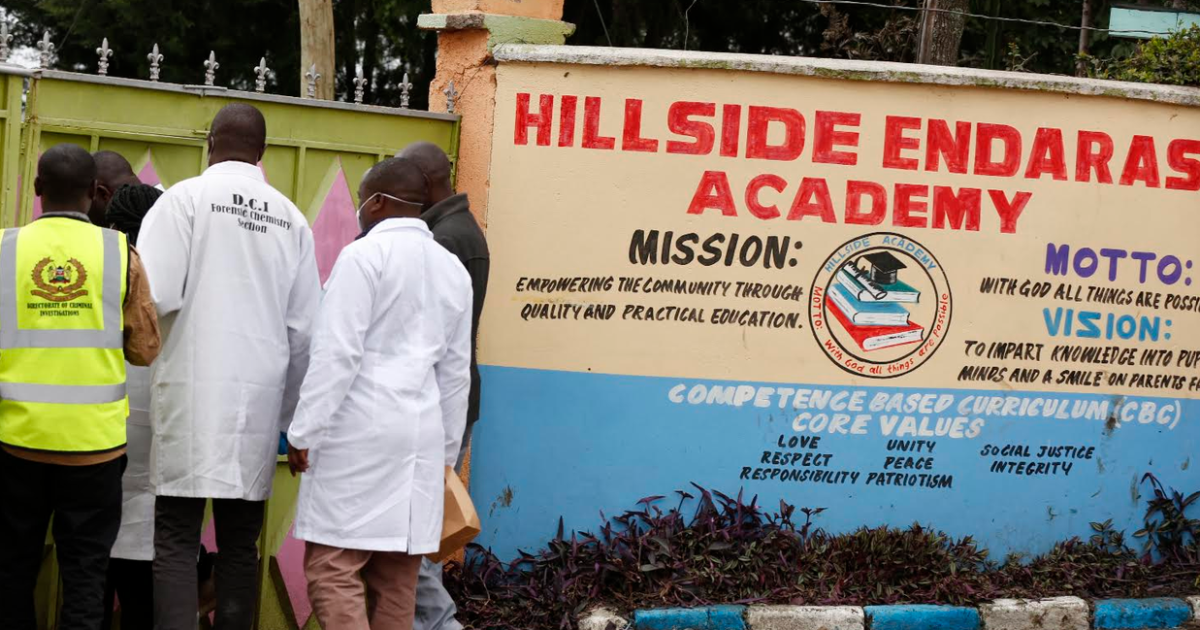
Findings of an investigation by the Energy and Petroleum Regulatory Authority into the September 2024 dormitory fire at the Hillside Endarasha Academy revealed widespread defects in the school’s electrical installation system.
During an inquest into the fire that claimed 21 boys, EPRA Electrical Engineer, Allan Mogoi, told the court that the school’s power distribution system did not meet the set standards for public institutions.
Mogoi told the inquest that their investigations laid bare numerous defects including lack of earthing, poor cable sizing and poor protection coordination in the school’s electrical installation system.
The energy sector regular also established that while the school’s original electrical installations were done by a licensed contractor, subsequent power extensions to the new buildings were undertaken by an unlicensed contractor prompting them to recommend that the Director of the school, David Kinyua be held culpable of the September 2024 dormitory fire for failing to engage a licensed contractor.
According to EPRA findings, the school had been supplied with electricity by a single-phase transformer which had an independent metre. The connection was such that all the electrical wires for the buildings originated from the administration block with many of them failing to meet the size specifications required by EPRA.
“The wires that were supplying these other blocks measured 4 square millimetres in size yet we usually require 6 square millimetres when you are doing sub-mains cables. The said dorm was drawing its supply from the kitchen using a 2.5 square millimetres cable. When supplying power to a structure like that, the cable should be 4 square millimetre or above, “said Mogoi.
“The installation in the kitchen did not meet the standard for hazardous areas.The cables that were running through the kitchen were covered in soot, they were not in conduits (protective pipes and to protect humans from being electrocuted), and they have a lot of joints which is not advisable. The cable coming from the store was running underground to the kitchen, it was not armored as we require, it was busting through an open area. The route was not labeled added.
The system was also protected by an oversized circuit breaker. That meant that in the event of an electrical fault, the circuit breaker could not function effectively. EPRA also found that circuit breakers throughout the school’s electrical system had been poorly graded, further reducing the effectiveness of the protection system.
Similarly, EPRA also found defects in the earthing system, a safety feature that involves connecting a non-current metal to the earth and is designed to protect the users from shock and stabilize the system’s voltage. Only four blocks had independent earthing despite EPRA recommendation that each independent building bears its own earthing. Further their probe found that two of the existing earthing’ had defects and could not function properly.
“The earth connection in the block housing Grade 3 had been severed and the earth rod for the kitchen had been buried in concrete so we could not ascertain whether that connection was full. None of the other buildings including the dormitories had earth rods,” said Mogoi.
The Authority also established that despite the school significantly expanding over the years, the school did not apply to the electricity supplier, Kenya Power and Lighting Company (KPLC) for additional load. Mogoi told the inquest that by failing to upgrade the electrical supply after increasing demand stressed the existing installation that could increase the risk of a short circuit.
“When you are first supplied with power, your initial load is estimated so the circuit supplying you will be based on the kind of load you applied for. If you add another building that means you have added another load. So, you are required to apply to KPLC for a separate load for that new building or you apply for an additional load,” he said.
“Because if you add more load, you are going to put more stress on the initial installation done by KPLC. So KPLC needs to come, assess the load and determine whether they need to upgrade the system or whether the existing system is sufficient,” he added.
Mogoi told the court that despite identifying the numerous electrical deficiencies, EPRA could not ascertain the cause of the deadly fire. He said that most of the electrical installations in the affected dormitory were extensively damaged by the fire making it impossible for EPRA to determine if the fire could have originated from the wiring.
“We could not ascertain the cause of the fire at that particular point. We did not find direct evidence that told us that an electrical fault occurred or a cable burnt. Then, part of the system that was within that dormitory was severely burnt to the point where we could not tell whether it was the one that started the fire or not,” said Mogori.
The authority also ruled out the school’s solar power back-up system as the source of fire, noting that no faults had been found in the main solar installations.
During the inquest, KPLC informed the inquest that its electricity distribution network to the school was operating normally before and after the incident.
The utility’s Mount Kenya Regional Manager, Engineer Mutegi Mbae testified that when they visited the school on September 6 to carry out their investigations, they found the transformer, supply cables, meter and the fuses on the transformer intact after the fire.
Eng Mbae told the court that adjacent customers who are also supplied electricity by the same transformer did not report any interference before and during the fire therefore ruling out the utility’s network as the cause of the fire.
“When we visited the site, we found KPLC installations intact. Upon inspection, we did not find any fault from the transformer to the power supply line. From our surveillance, there was no indication of fault, overload or power surge before or on the day of the incident,” said Eng Mbae.
The inquest is trying to piece together the series of events that took place at the school on the night of September 5, 2024, just two days after the school had re-opened for Third Term. The fire is reported to have broken out at between 10pm-11pm on that fateful Thursday night.
On Monday, the court also heard testimonies from four witnesses among them a government analyst at the Government Chemist who confirmed that all 21 victims were positively identified through DNA matching.
The court also heard the testimony of Peter Ndumia, a licensed solar expert who was contracted by the school to install the solar back-up system in 2022.
Ndumia told the inquest that the solar power, which was manually activated, was off at the time of the fire.
The inquest continues on Tuesday (today) when three teachers are expected to testify.
By Wangari Mwangi and Sharon Nashipae